
Why Test Results Vary Between Labs: Multi-Lab COA Comparison
Six Labs Tested the Same Retatrutide Kit. The Results Were Close, Weird, and Very Educational.
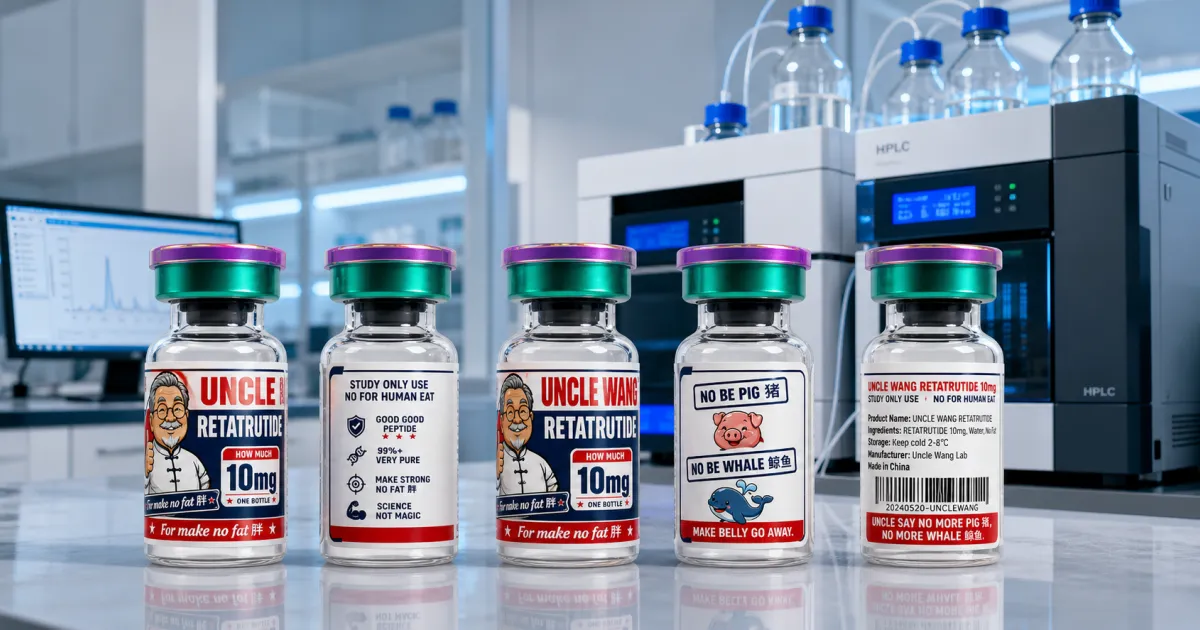
We recently tested a kit of Uncle Wang Retatrutide 10mg from Nexaph across several independent labs, including Analytical Formulations Inc. (AFI), Freedom Diagnostics, Janoshik, TrustPointe Analytics, Vanguard Laboratory, and the original vendor-provided Janoshik report.
The short version: the labs mostly agreed on the big picture. The material tested as retatrutide, and the purity results were consistently high. The more interesting part was the mass, or net content, where the numbers moved around more than casual COA readers might expect.
That does not mean one lab is the chosen prophet and everyone else is huffing solvent fumes in a broom closet. It means analytical chemistry is a method-driven process. Different labs use different equipment, different sample prep, different calibration assumptions, different software integration, different analysts, and sometimes different vials from the same kit.
Welcome to the part of peptide testing where the science is real, the numbers are useful, and the internet still tries to turn every decimal point into a cage match.
The Big Picture: Purity Agreed, Mass Argued
The most important thing to understand is that purity and mass are not the same measurement.
Purity asks how clean the main peptide peak looks compared to other detectable peaks under that lab's method.
Mass or net content asks how much retatrutide is actually in the vial.
A vial can be very pure and still contain different measured amounts of peptide. A 99.9% purity result does not automatically mean the vial contains exactly 10.00mg. It means the detected peptide peak is very clean relative to the detected impurity peaks.
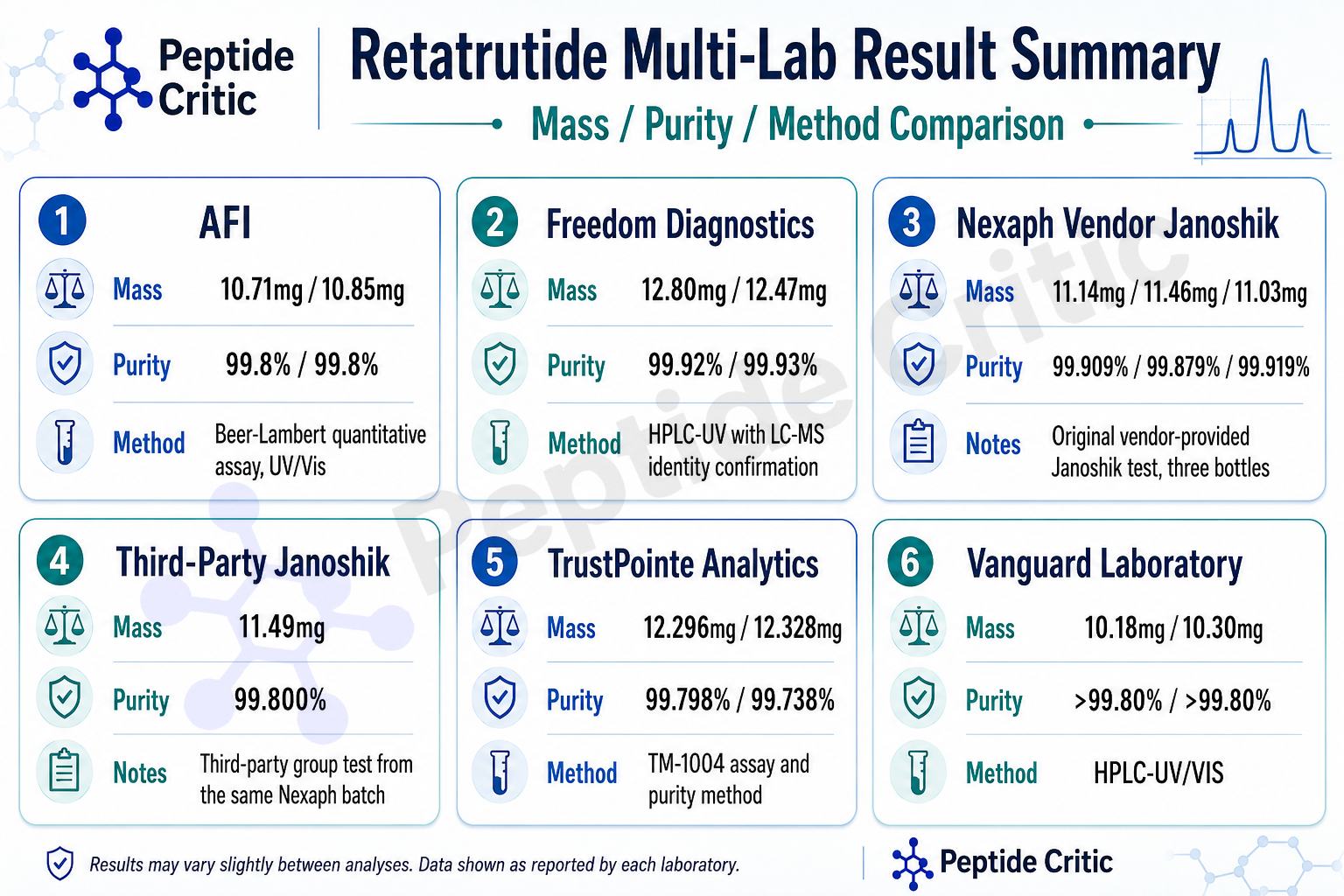
In this round of testing, the purity numbers were all in the same neighborhood, roughly 99.7% to 99.9% depending on the lab and report. The content results showed more spread, ranging from about 10.18mg to 12.80mg per vial.
That spread is the article. That is the lesson. That is where Randy the Research Rat puts on his little lab coat and tells everyone to stop treating one COA like it came down from Mount Sinai.
Result Summary
Nexaph Is Also Known for Overfills
One important piece of context: Nexaph has become known in this space for overfilled kits. So seeing numbers above the stated 10mg label claim is not automatically surprising.
The vendor Janoshik report showed three bottles at 11.14mg, 11.46mg, and 11.03mg. The third-party Janoshik report came back at 11.49mg. Those results line up pretty well with the idea that this kit was not underfilled, and may have been intentionally or routinely overfilled.
But this is where people need to be careful. "Nexaph overfills" does not mean every lab must report the same overfill number. It means the general direction makes sense. The exact measured content still depends on the lab, the method, the sample, and how the assay is performed.
Why the Numbers Can Vary
1. Different Labs Are Not Running the Exact Same Test
People love to say "it was tested by HPLC" as if HPLC is a magic slot machine where you insert a vial and receive Universal Truth.
That is not how this works.
HPLC is a platform. The final result depends on the column, mobile phase, gradient, detector wavelength, injection volume, sample concentration, calibration curve, integration settings, standards, and analyst decisions. Two labs can both use HPLC and still run meaningfully different methods.
In this group, the labs listed different approaches. AFI used a UV/Vis Beer-Lambert quantitative assay. Freedom Diagnostics listed HPLC with UV detection coupled with mass spectrometry. Vanguard listed HPLC-UV/VIS. TrustPointe used its TM-1004 assay and purity methods. Janoshik reported peptide content and purity through their HPLC-MS workflow.
Those are not identical analytical pipelines. They are different scientific keyholes pointed at the same peptide.
2. Mass Testing Is More Method-Sensitive Than Purity Testing
Purity is usually a relative measurement. It looks at how much of the detected chromatogram belongs to the main peptide peak compared with other detectable peaks.
Mass or net content is a quantitative measurement. It tries to estimate how many milligrams of peptide are in the vial.
That second question is harder. It depends heavily on calibration, reference standards, sample prep, dilution accuracy, and how the lab defines or reports peptide content.
That is why the purity results can all look very similar while the mass results spread out more. The purity results are sitting at the same lunch table. The mass results are in the group chat arguing.
3. Different Vials From the Same Kit May Not Be Identical
The original vendor Janoshik test reported three bottles from the same batch at 11.14mg, 11.46mg, and 11.03mg. That alone shows that even inside one batch, individual vials are not perfect clones.
Lyophilized peptide filling is not a Star Trek replicator. A batch can be consistent enough to be useful while still having vial-to-vial variation.
So when different labs test different bottles, the comparison includes two layers of variation:
- Actual vial-to-vial fill variation
- Lab-to-lab method variation
Both matter.
4. Some Labs Were Internally Consistent, Even When They Disagreed With Each Other
This is one of the most useful findings.
TrustPointe reported 12.296mg and 12.328mg, which are very close to each other. Vanguard reported 10.18mg and 10.30mg, also close to each other. AFI reported 10.71mg and 10.85mg, again close to each other.
That suggests each lab may have been reasonably repeatable inside its own method. The bigger disagreement appears when comparing one lab's method against another lab's method.
That is an important distinction. Repeatability inside one lab is not the same thing as perfect agreement across all labs.
5. Calibration and Reference Standards Matter
For quantitative peptide testing, the lab needs a way to convert instrument response into a concentration or mass estimate. That usually involves calibration, a reference standard, response factors, extinction coefficients, or other method-specific assumptions.
If one lab's calibration curve or standard behaves differently from another lab's, the final content number can shift. Not because someone is necessarily wrong, but because the assay is built differently.
This is the part people miss when they treat COAs like sports scores. A lab result is not just the machine talking. It is the machine, the method, the standard, the software, and the human running the process.
6. Sample Prep Can Move the Number
Before the sample ever reaches the instrument, someone has to prepare it.
That may involve dissolving the lyophilized cake, rinsing the vial, transferring liquid, choosing solvent, making dilutions, mixing thoroughly, preventing peptide loss to glass or plastic, and making sure the entire sample is represented.
Small differences can matter. A slight pipetting difference, incomplete dissolution, peptide sticking to a surface, or a dilution error can shift the final calculated content.
This is why the analyst matters. The lab tech is not just pressing the Big Science Button while the machine prints out peptide commandments.
7. "10mg" Is Not Always a Simple Scale Weight
With peptides, "mg per vial" is often a calculated analytical result, not simply someone weighing dry powder on a scale.
Depending on the lab and method, the reported number may be affected by how the assay treats water content, salt form, counterions, residual solvents, net peptide content, and the reference standard used for comparison.
This is especially relevant in the research peptide market, where label claims are often treated as simple numbers, but the underlying chemistry is not always simple.
Why Purity Does Not Tell the Whole Story
A high purity number does not automatically tell you the exact amount of active peptide in the vial.
HPLC purity generally tells you how dominant the main peptide peak is under the method used. It does not necessarily account for every form of mass in the vial, including water, salts, counterions, or other material that may not show up the same way under that method.
So when a report says 99.9% purity, that usually means the detectable peptide-related profile looks very clean. It does not mean the entire physical vial is 99.9% active retatrutide by dry weight.
Purity is about cleanliness. Mass is about quantity. Identity is about whether the compound is what it claims to be. They are related, but they are not interchangeable.
The Individual Test Reports
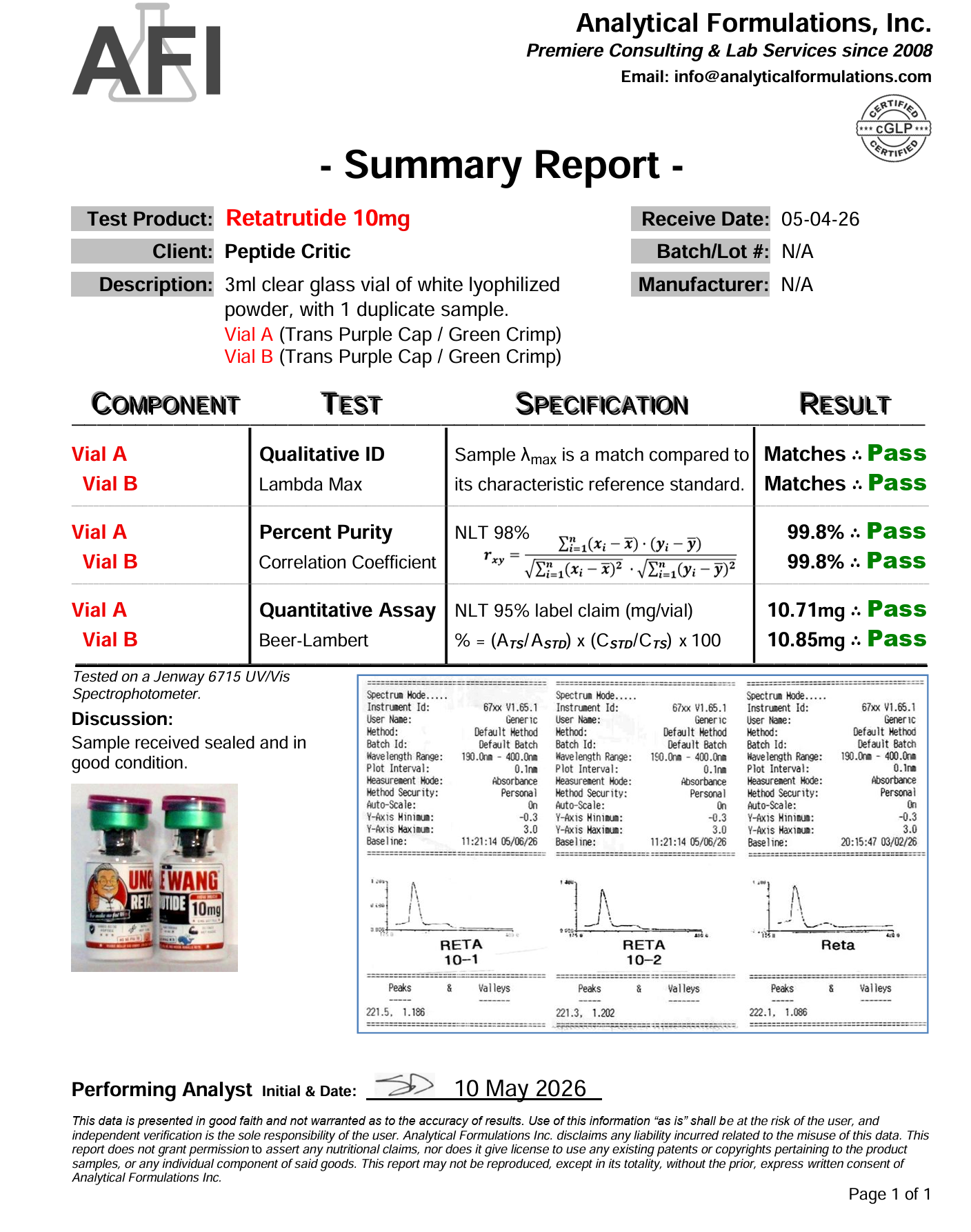
Click image to open full report.
AFI Retatrutide Test
AFI reported both samples as matching retatrutide, with 99.8% purity and quantitative assay results of 10.71mg and 10.85mg.
This placed AFI on the lower side of the content range compared with some of the other labs, but the two AFI results were very close to each other. That matters. It suggests the lab's method was internally consistent, even if its content result landed lower than Freedom Diagnostics or TrustPointe.
AFI's result is a good example of why one lab's result should be viewed as one method's answer, not the final word carved into a stone tablet by the peptide gods.
Click image to open full report.
Freedom Diagnostics Retatrutide Test
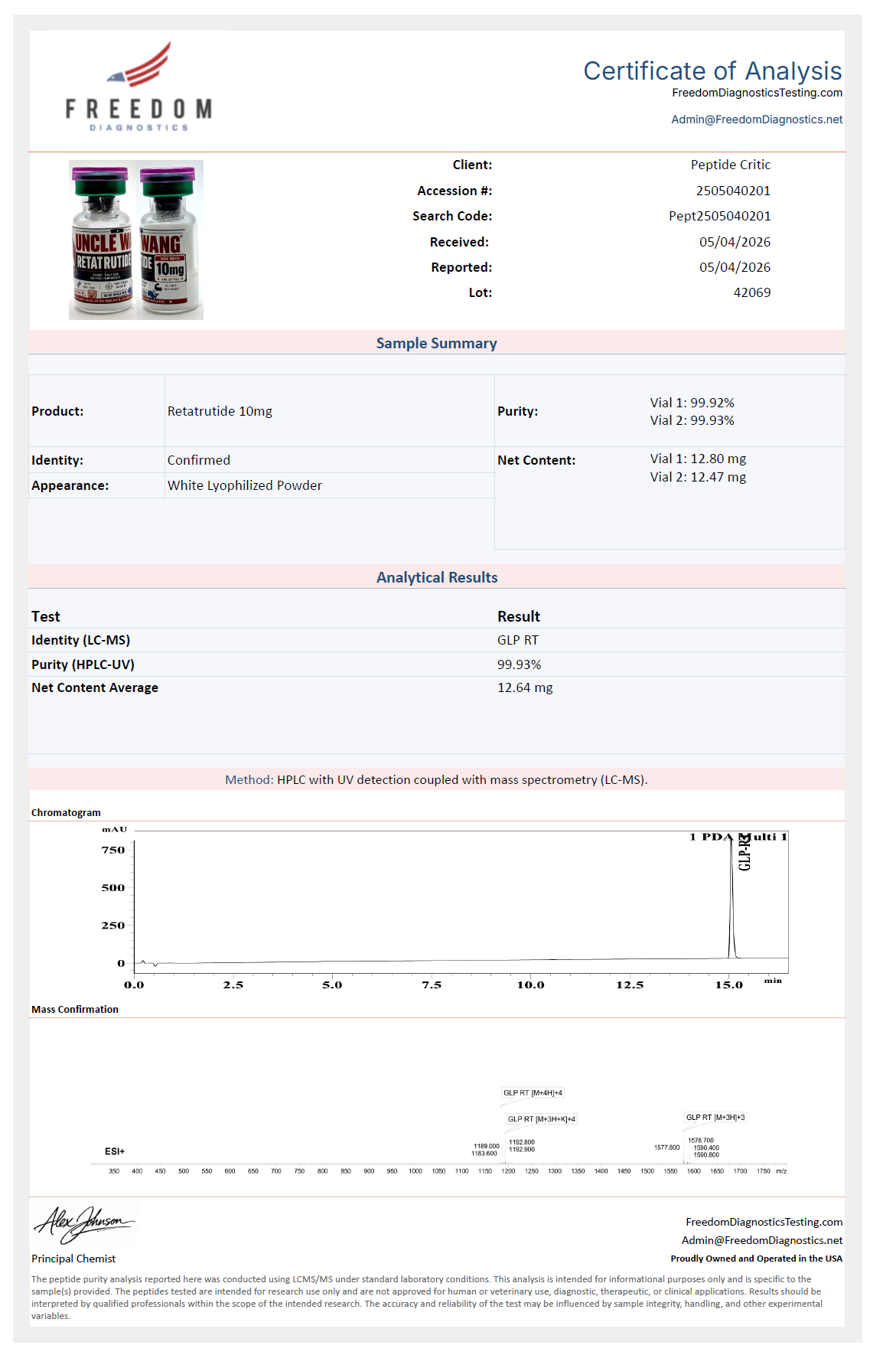
Freedom Diagnostics reported identity confirmed, purity of 99.92% and 99.93%, and net content of 12.80mg and 12.47mg.
That puts Freedom on the higher side for mass in this comparison. The purity result, however, still lines up with the rest of the labs: very clean material, with the disagreement mostly appearing in the content number.
This is exactly why multi-lab testing is useful. Freedom's result does not need to be thrown out just because another lab came in lower. It shows how a different method, calibration setup, and sample prep workflow can produce a different quantitative answer while still agreeing on the larger purity story.
Click image to open full report.
Nexaph Vendor Janoshik Test
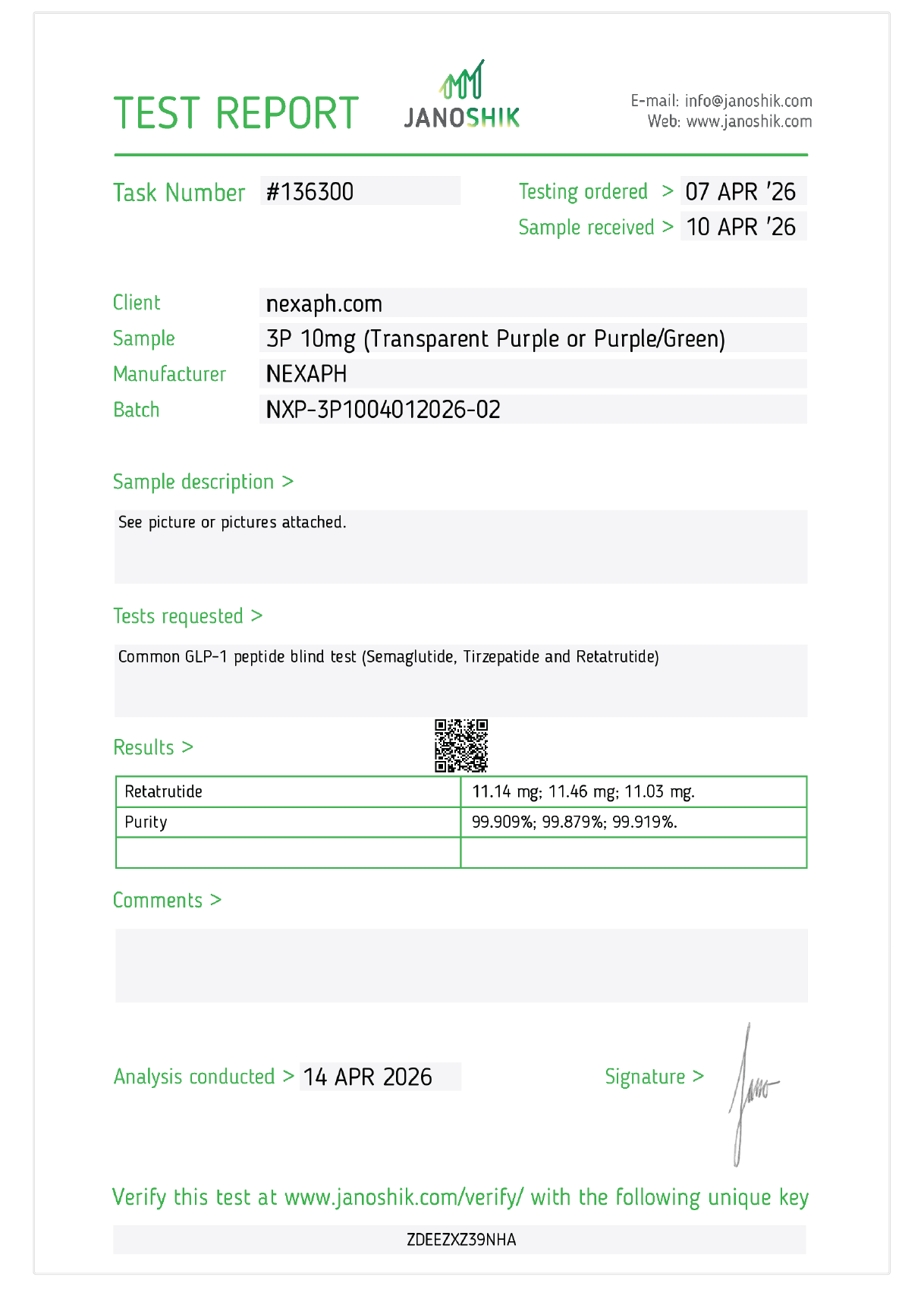
The original vendor-provided Janoshik report listed three bottles at 11.14mg, 11.46mg, and 11.03mg, with purity results of 99.909%, 99.879%, and 99.919%.
This report is useful because it tested three bottles, not just one. Even within the same vendor report, the content was not identical from vial to vial. That is not shocking. It is actually the kind of data point people should pay attention to before declaring every difference between labs a conspiracy.
It also fits the broader context that Nexaph is known for overfills. The vendor report does not show a kit scraping by at 10.00mg. It shows bottles over the 10mg label claim.
Click image to open full report.
Third-Party Janoshik Test
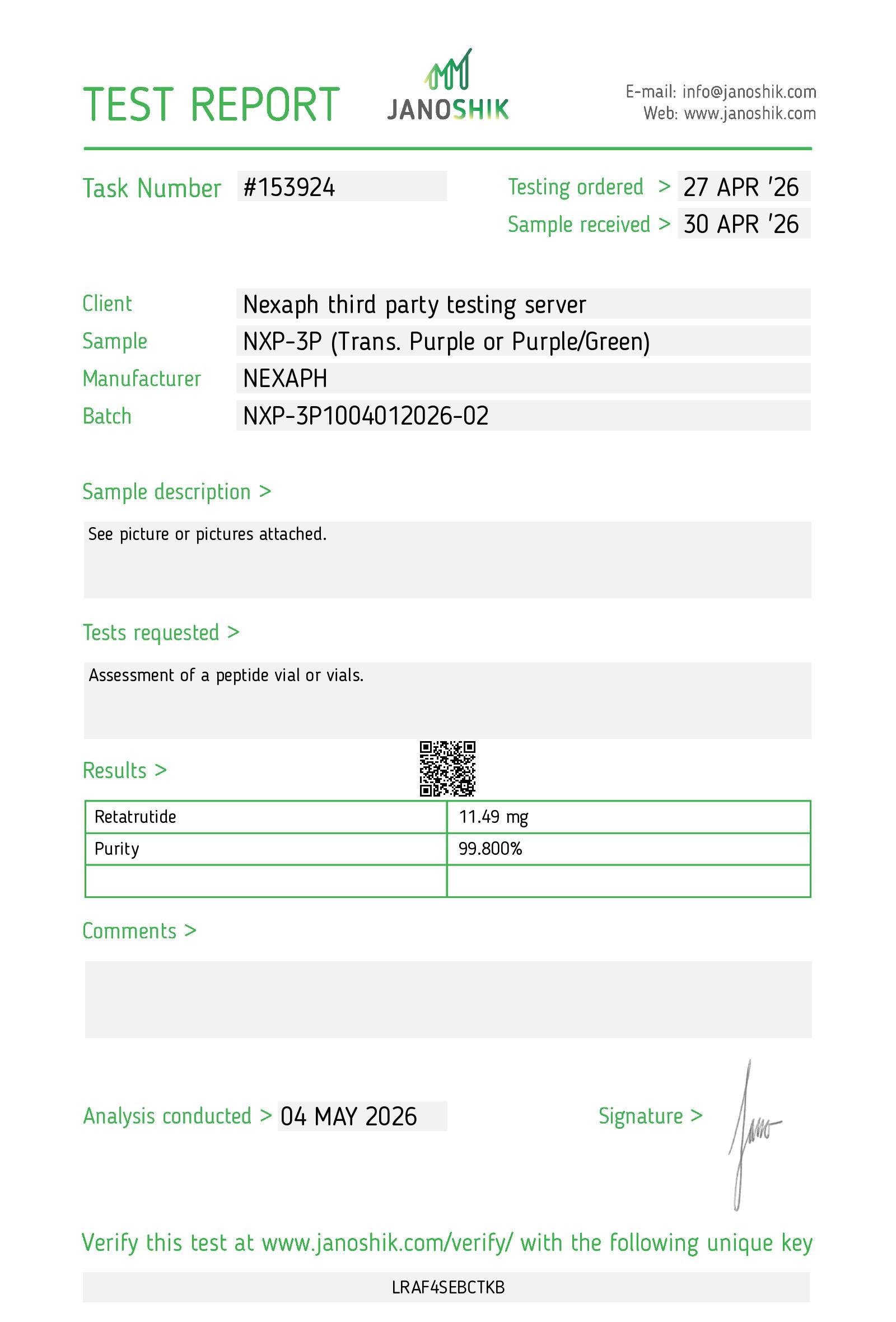
The third-party Janoshik report listed retatrutide at 11.49mg and 99.800% purity.
This is interesting because it lands very close to the vendor's Janoshik range. The vendor's three bottles were reported at 11.14mg, 11.46mg, and 11.03mg, while the third-party Janoshik sample came back at 11.49mg.
That does not prove every vial in the kit is exactly 11.49mg. It does show that the vendor Janoshik result and the third-party Janoshik result are broadly aligned, which supports the idea that this kit was likely over the 10mg label claim.
Click image to open full report.
TrustPointe Analytics Retatrutide Test
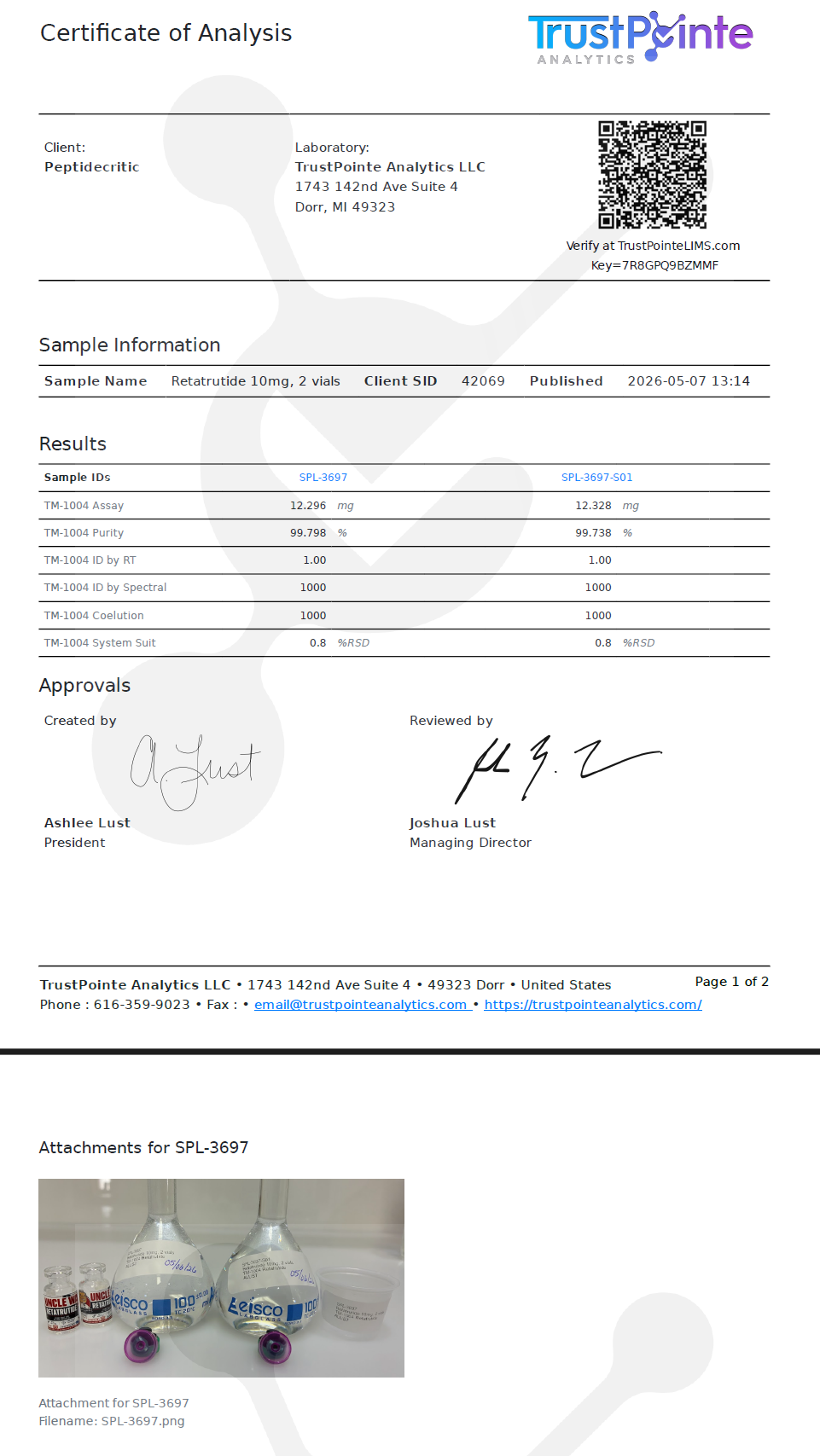
TrustPointe Analytics reported assay results of 12.296mg and 12.328mg, with purity results of 99.798% and 99.738%.
The two TrustPointe content results were extremely close to each other. That is a useful detail because it suggests repeatability inside the TrustPointe method.
TrustPointe landed on the higher side for mass, closer to Freedom Diagnostics than AFI or Vanguard. Again, that does not mean TrustPointe is automatically right and Vanguard is automatically wrong. It means TrustPointe's method produced a higher content estimate while still agreeing with the rest of the labs that the material was highly pure.
Click image to open full report.
Vanguard Laboratory Retatrutide Test
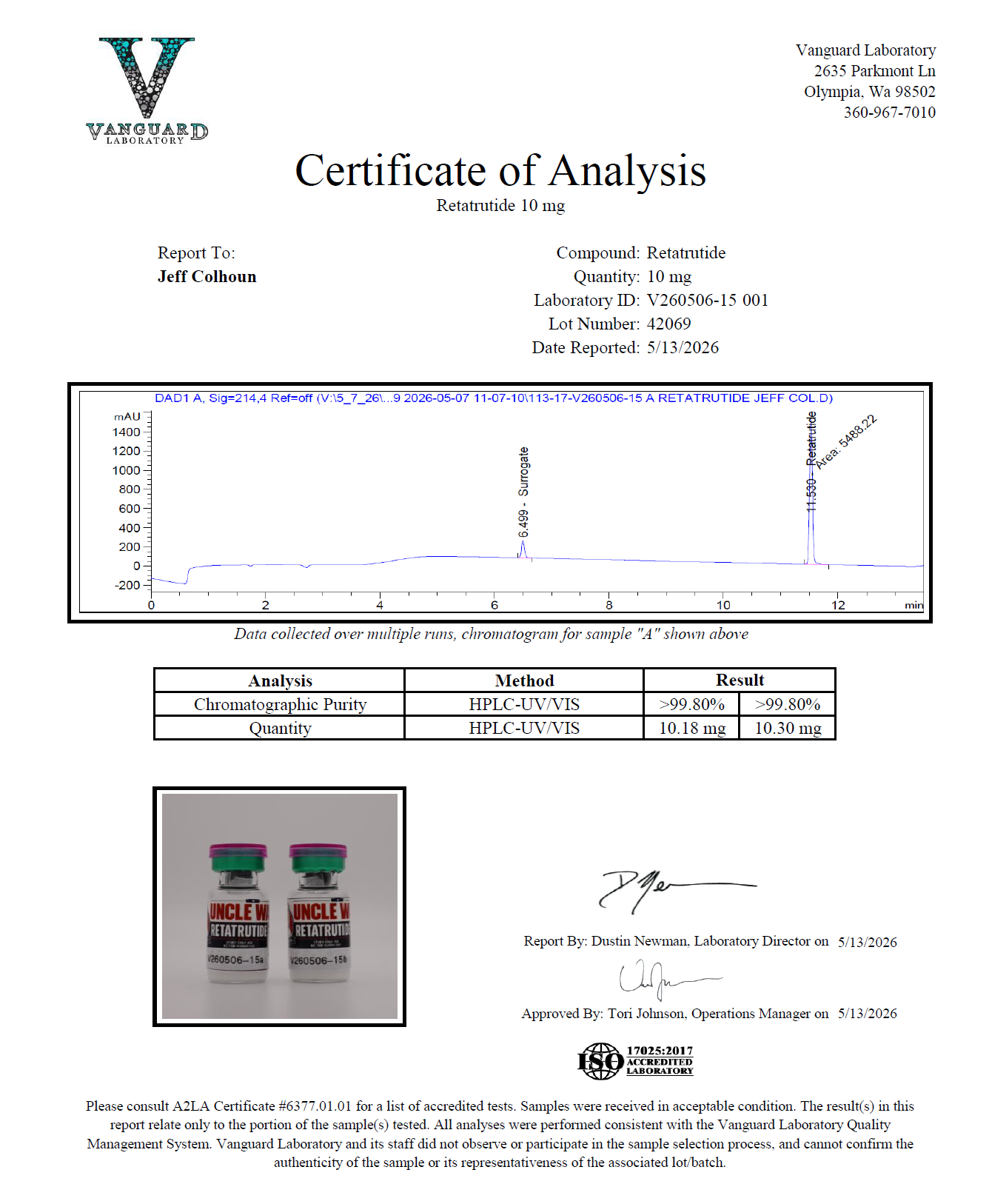
Vanguard Laboratory reported chromatographic purity greater than 99.80% and quantity results of 10.18mg and 10.30mg.
Vanguard came in as the lowest content result in this comparison, but its two numbers were close together. Like AFI and TrustPointe, that internal consistency matters.
Vanguard's result is the perfect example of why this article exists. If someone only saw the Vanguard report, they might conclude the kit was just barely over 10mg. If someone only saw TrustPointe or Freedom, they might conclude the kit was massively overfilled. The better interpretation is that the exact content number depends on method, calibration, sample prep, vial selection, and analyst execution.
The Fair Interpretation
The fairest interpretation is not that one lab is right and everyone else is wrong.
The fair interpretation is this:
- The samples consistently tested as retatrutide.
- The purity results were consistently high across labs.
- The kit does not appear underfilled against a 10mg label claim.
- Nexaph's reputation for overfills is consistent with several of the higher content results.
- The exact mg-per-vial number varied materially depending on the lab and method.
That is not a scandal. That is actually why multi-lab testing is useful.
One COA gives you one lab's answer from one method on one sample. Multiple labs give you a pattern. And in this case, the pattern is pretty clear: high purity, confirmed identity, and content that appears at or above the label claim, with normal but meaningful method-driven variation in the exact mass result.
The Bottom Line
COAs are useful, but they are not sacred texts. They are snapshots produced by a specific lab, using a specific method, on a specific sample, at a specific time.
When multiple labs test the same product, the goal should not always be to crown one lab king and throw the others into the peptide dungeon. The goal is to understand the pattern.
Here, the pattern is simple enough:
The labs agreed that the retatrutide was highly pure. They disagreed more on exactly how much was in the vial. That difference is likely driven by a combination of vial variation, method differences, calibration, sample prep, equipment, software integration, and analyst execution.
Or, in Randy terms:
The peptide looks clean. The fill looks generous. The decimal points are where the rats start fighting.
Research Use Disclaimer
This article is for informational and research discussion purposes only. Peptide Critic does not provide medical advice, dosing guidance, or human-use recommendations. Products discussed are for research use only and are not for human or veterinary use.
Community Discussion