
I Clicked the First Peptide Ad Facebook Showed Me. Every COA Was Stolen.
Every few days, someone arrives on the Peptide Critic forum asking us to verify their special source.
The company usually has a name like QX BioTech Global Factory Direct International. The sales rep is named Lulu, Jenny or Tansy. The corporate headquarters is a WhatsApp profile with an anime avatar, and the complete due-diligence package consists of a price list, a heart emoji and the phrase, “All of our products have a purity of over 99.”
Very reassuring.
These sellers advertise on Instagram, Facebook and TikTok, then funnel buyers into WhatsApp. In my experience, the result is more often than not a scam, or at minimum a completely unverified transaction with a stranger using stolen or fabricated lab reports to manufacture credibility.
They may take your money and disappear. They may also ship you something. That second outcome is not the victory it sounds like. Receiving a vial full of white powder is not independent verification.
AFI Ruins Someone’s Weekend
I recently received an email from John at Analytical Formulations, Inc., better known in the peptide space as AFI. John is what we call a man of the people. He has been running his lab longer than I have technically qualified as an adult and he runs the tests you've seen in a lot of our content.
Someone had contacted AFI trying to verify a stack of reports being used by a WhatsApp seller. John forwarded roughly 40 COAs that AFI said had been doctored. These were not subtle, masterful forgeries constructed by an international criminal syndicate. They were poorly altered lab reports being passed around to help sell research products through social media ads.
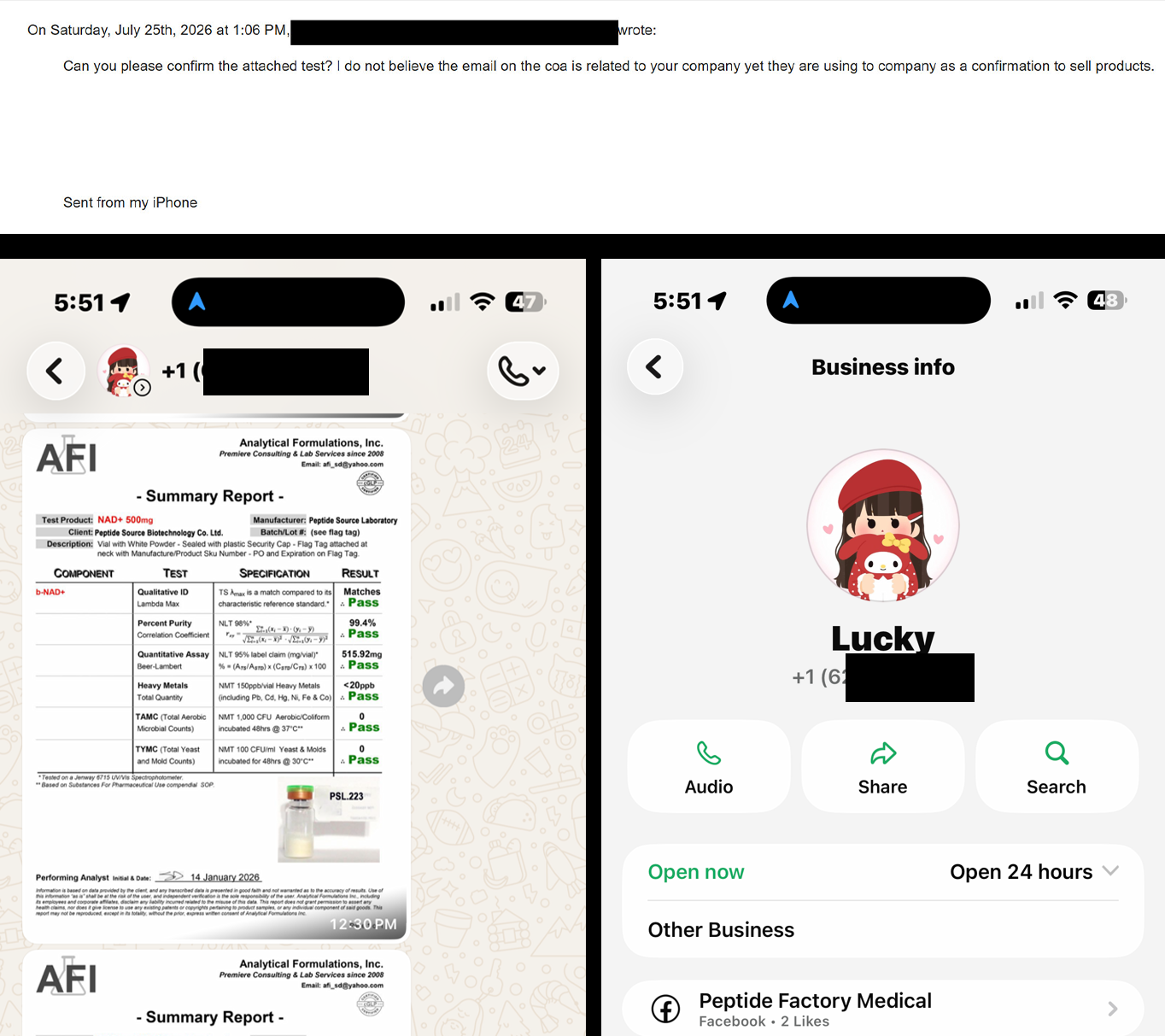
The seller was not merely saying, “Trust me, dear.” They were using AFI’s name and the appearance of laboratory testing to manufacture trust that AFI had not given them.
That is the entire point of the COA in this transaction. Most buyers cannot interpret chromatography, confirm a sample ID or trace a vial back through a testing submission. They see a laboratory logo, a purity number in green and the word “Pass.” The seller knows that is often enough.
Everyone Wants a Secret Source
We see some version of this constantly on the forum.
Someone asks whether anybody has heard of a WhatsApp seller named Lulu using an acronym for a company name. The buyer has usually already decided the source is legitimate and would now like the community to congratulate them for discovering the peptide equivalent of a hidden speakeasy.
I understand the appeal. Everyone wants to believe they found the direct factory connection. No middleman. No retail markup. Just you, a “manufacturer,” and a WhatsApp account created in May.
But a private contact is not automatically an insider connection. Sometimes it is simply a stranger whose ad found you before our forum did.
There are legitimate manufacturers and exporters in China. Geography is not the test. The problem is the zero-accountability funnel: a disposable social media ad, an unverifiable company identity, a chat app and paperwork that was either stolen from another seller or fabricated outright.
Jeff Conducts an Investigation
I have seen plenty of these ads, but I generally avoid clicking them because I value my time and already receive enough messages beginning with “Hello dear.”
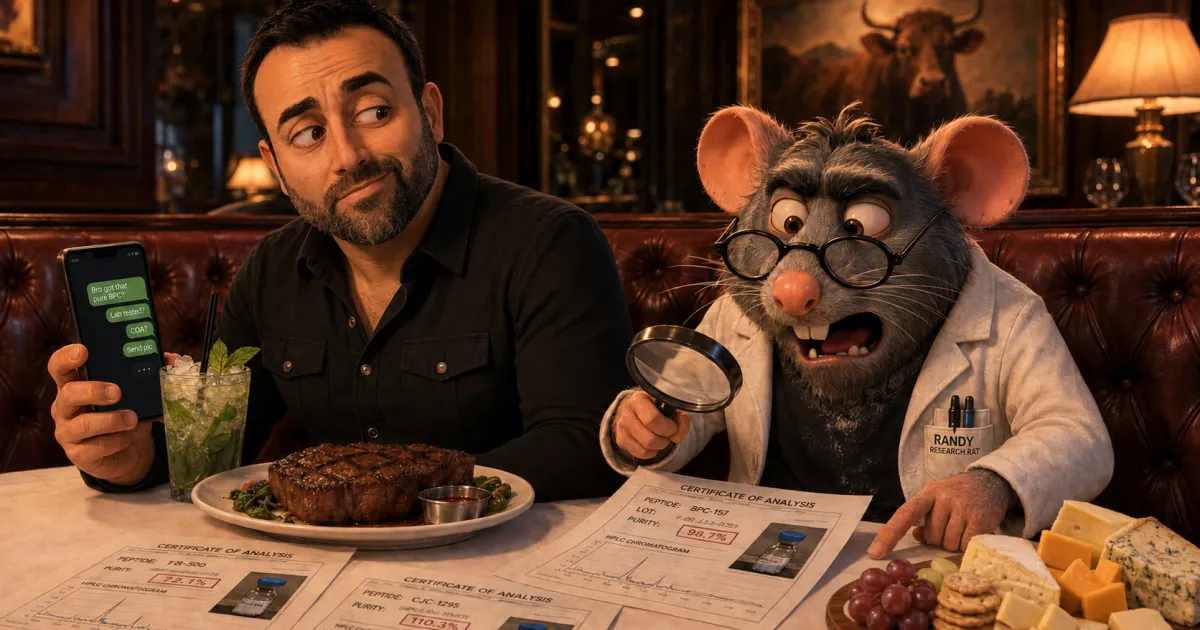
Unfortunately, I recently had a mojito while sitting alone at my usual steakhouse. Bad Jeff.
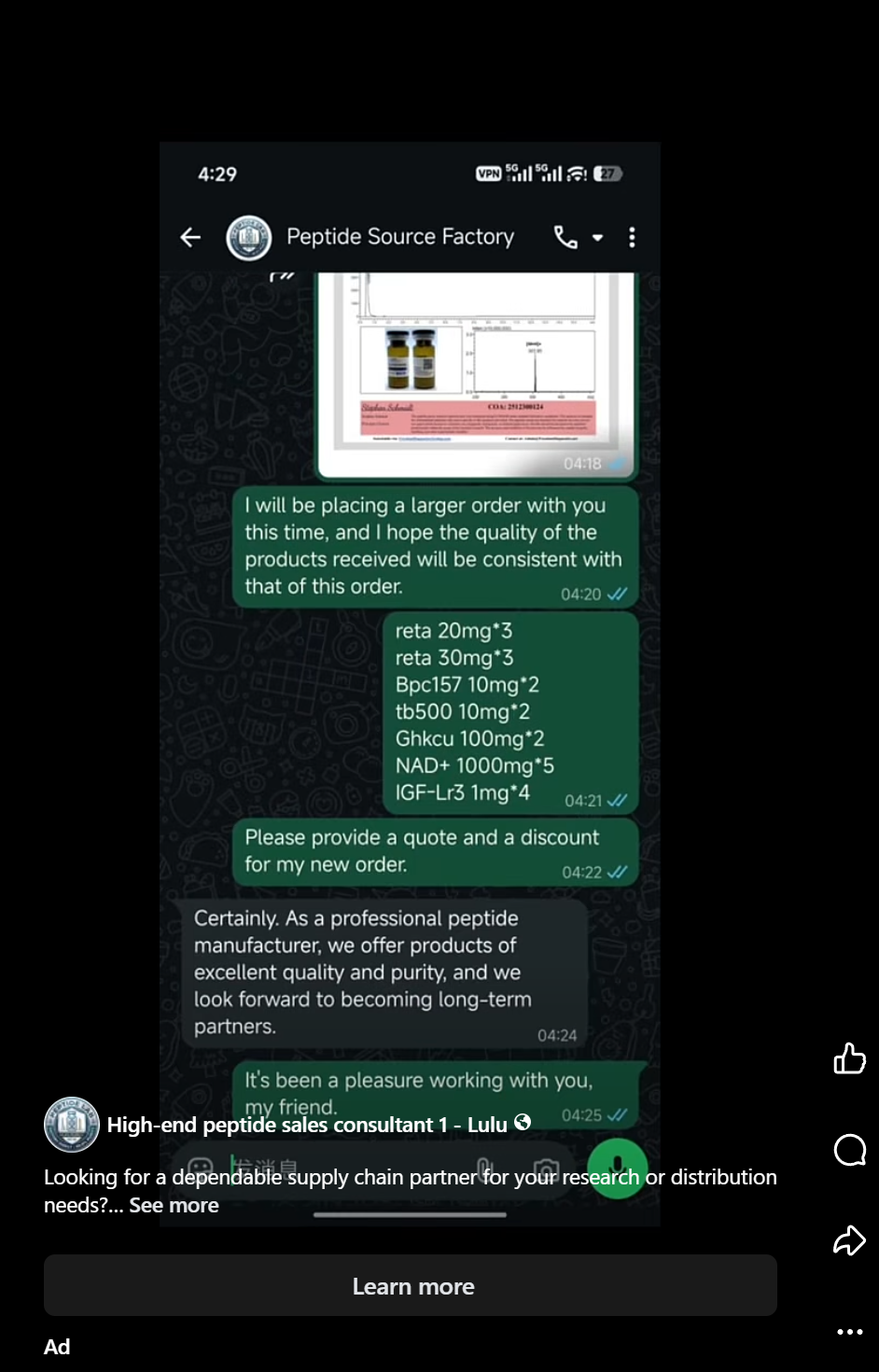
An ad for “Peptide Source Factory” appeared in my feed, so naturally I clicked it and entered the funnel. To be clear, I did not spend three weeks clicking dozens of ads until I finally found a scammer. This was the first peptide ad I clicked.
One mojito. One ad. One scammer.
I opened the conversation with:
“hello dear. how are you? do you have COA for very pure nice peptide? I am very serious buyer and not investigative journalist :)”
This is, of course, exactly how a normal peptide wholesaler introduces himself. The only problem was that I am, in fact, an investigative journalist. But I added a smiley face, which I believe made the lie legally binding. That is tradecraft.
My cover was airtight.
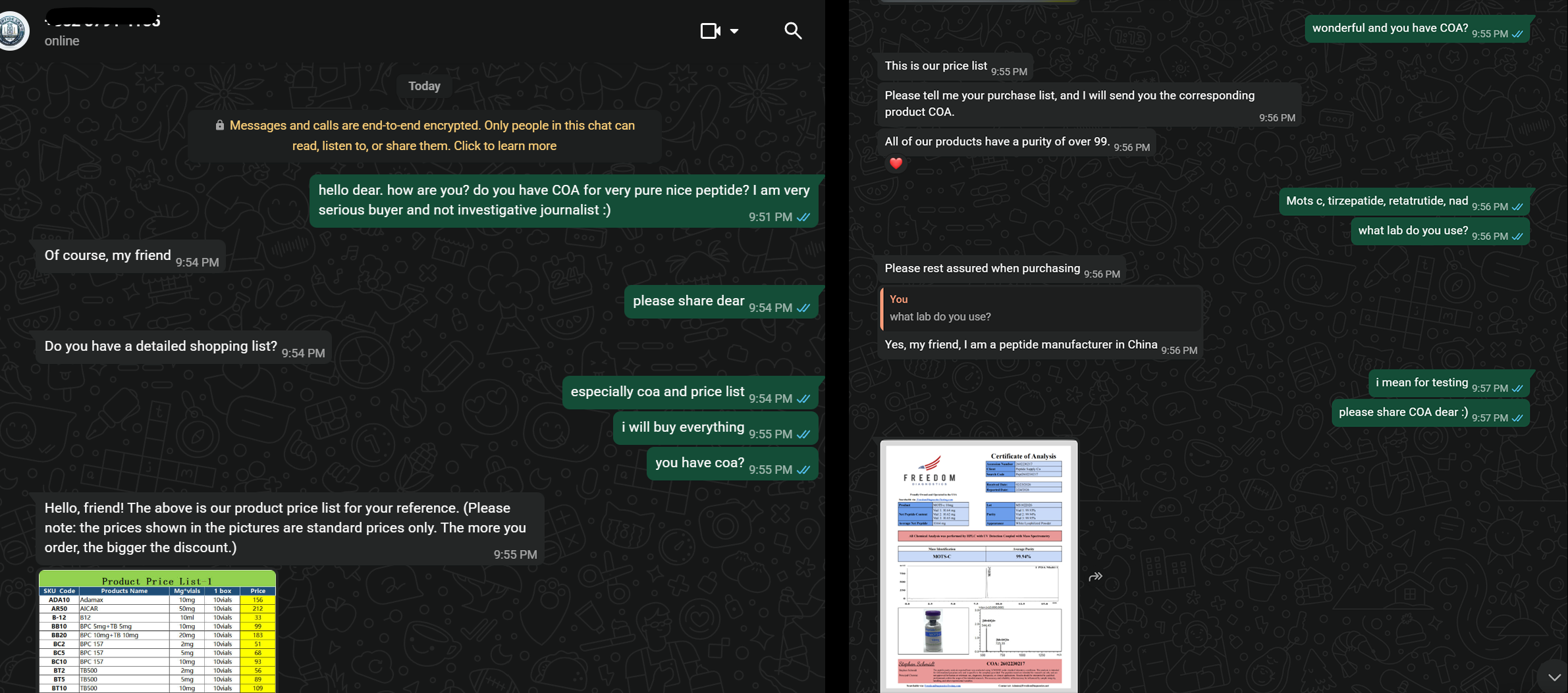
The seller sent a large price list and assured me that every product had purity over 99. When I asked what lab they used, they told me they were a peptide manufacturer in China.
That was not the question, but confidence is confidence.
After I requested COAs for MOTS-c, tirzepatide, retatrutide and NAD+, they sent testing. Every COA they provided had been stolen from Peptide Supply Co. The documents were around five months old and were issued to Peptide Supply Co., not “Peptide Source Factory” or the person selling to me through WhatsApp. Each report included a photograph of a Peptide Supply Co. retail vial directly on the COA, because apparently even removing the evidence of the theft was too much administrative work.
These were not the seller’s reports. They had not tested the products they were offering me. They stole an entire set of Peptide Supply Co. COAs and used them as sales material for unrelated inventory.
On the first ad I clicked, I landed directly in a conversation with a scammer using an entire set of stolen COAs. The COAs were not evidence for the seller’s products. They were stolen props.
A Real COA Can Still Be Worthless
This is where buyers get confused. There are two versions of the scam in these screenshots.
In the AFI example, the reports were fabricated by doctoring AFI paperwork. In my WhatsApp conversation, the seller sent an entire set of COAs issued to Peptide Supply Co. Those reports were stolen and reused to sell unrelated products. One scam creates fake evidence. The other steals real evidence and attaches it to a fake claim.
A COA can be completely authentic and still prove nothing about the product being offered to you.
If Company A sends one vial to a laboratory and receives a valid report, Company B cannot wave that report around five months later and claim it covers everything on its own price list. There is no demonstrated connection between the tested sample and Company B’s inventory. There is no chain of custody. There is not even a shared label in this case.
Ask three basic questions:
- Who paid for and submitted the sample?
- Can the report be verified directly with the laboratory?
- What connects that exact tested sample to the batch being sold now?
If the answer to all three is “dear, please rest assured,” you do not have verification. You have customer service.
But Facebook Approved the Ad
One of the strangest assumptions in this space is that an ad must be legitimate because Facebook or Instagram allowed it to run.
Why would Facebook allow scammers to advertise?
Facebook allows us to advertise, and cave trolls on Telegram call us scammers constantly. Ad approval is not due diligence.
There is no meaningful barrier to entry between “I would like to sell peptides” and “Learn More.” A polished ad can be assembled in 40 seconds on ChatGPT. A WhatsApp Business account can be newer than the report it is using. A lab logo can be copied in seconds.
The ad platform is selling access to your attention. It is not certifying the contents of a vial.
Use the Tools That Already Exist
This is the part where I sell you Peptide Critic, except nearly everything I am selling is free.
We built a peptide pricing tool so you can see whether the “factory direct” deal in your DMs is actually a deal. We have vendor pages, alerts and reviews written by real customers. Vendors now ask, and sometimes beg, to be added to the site. Being listed does not guarantee a gold star. If I add a vendor and discover that it is presenting someone else’s testing as its own, I put a large red warning on the page.
We also have a community where people can ask questions before sending money to Lucky, Lulu or QX International Very Pure Friendship Biotech. Our Grey Zone section covers the sources most review sites refuse to discuss, and it lets members compare prices, testing and actual experiences in public.
Most of the other communities in this space want money before they let you see the useful part. Ours does not. Peptide Critic earns money when some vendors participate as affiliates, and we are strict about those relationships. Affiliate status does not buy a clean review, remove a warning or turn stolen or fabricated testing into valid testing.
You can use the pricing tools, read the reviews and join the community for free.
Our pens are not free, obviously. I have a steak habit and Randy likes cheese.

The Public Service Announcement
Do not buy research products because a Facebook ad sent you to WhatsApp. Do not trust a TikTok seller because the video has a clean lab background and a woman in a white coat. Do not accept a COA simply because it contains charts, green numbers and a logo belonging to a real laboratory.
Verify who submitted the sample. Verify the report with the lab. Verify that the test actually belongs to the batch being sold.
And if your source’s entire verification process is a heart emoji followed by “please rest assured,” perhaps do not rest assured.
Come use the free tools. Ask the annoying questions in public. Let the community look before you pay.
Your secret source probably is not secret. They bought an ad.
Peptide Critic reports on the research peptide market. Nothing in this article is medical advice or an endorsement of any product for human use. Statements concerning altered AFI reports are based on information provided by AFI.
Community Discussion