
ILS Labs Can’t Fill Out a PDF, but Please "Trust the Science"
At Peptide Critic, we have now written about ILS Labs enough times that I am beginning to feel like their unpaid quality-control department.
Unfortunately, every time I put down the red pen, another COA slides under the door making circus noises.
For anyone just joining the ILS Cinematic Universe, let’s recap.
Episode One: The Dog Was the Vial
ILS introduced a client-portal feature allowing customers to upload vial photographs after submitting their samples. One of our community members tested the feature by uploading a picture of his dog.
Not a vial beside a dog.
Not a dog holding a vial.
Just a dog.
ILS placed the photograph on the finalized MOTS-C certificate, marked the sample as passing, reported 99.77% purity, and confirmed the identity as MOTS-C. The only thing in the official sample photograph that could confidently be identified was a deeply enthusiastic household pet.
ILS apparently fixed the upload system after our article.
Good work, guys. You successfully added “dog recognition” to the laboratory workflow.
The dog, meanwhile, remains the most believable thing ILS has ever placed on a COA.
Episode Two: Chemistry Achieves Perfection
A little over a week later, ILS released a retatrutide report showing 100.00% peptide purity, confirmed identity, and 20.57 mg of peptide content.
Not 99.8%.
Not 99.97%.
Not “no additional peptide-related peaks detected above the reporting threshold.”
Exactly 100.00%.
ILS had apparently synthesized or discovered retatrutide free from degradation, deletion sequences, manufacturing remnants, analytical uncertainty, and original sin.
We wrote about that too.
Our working theory was that ILS counted one qualifying peak, divided that peak by itself, and accidentally discovered perfection.
Apparently that was not a one-time miracle.
Episode Three: We Don’t Know What It Is, but It’s Perfect
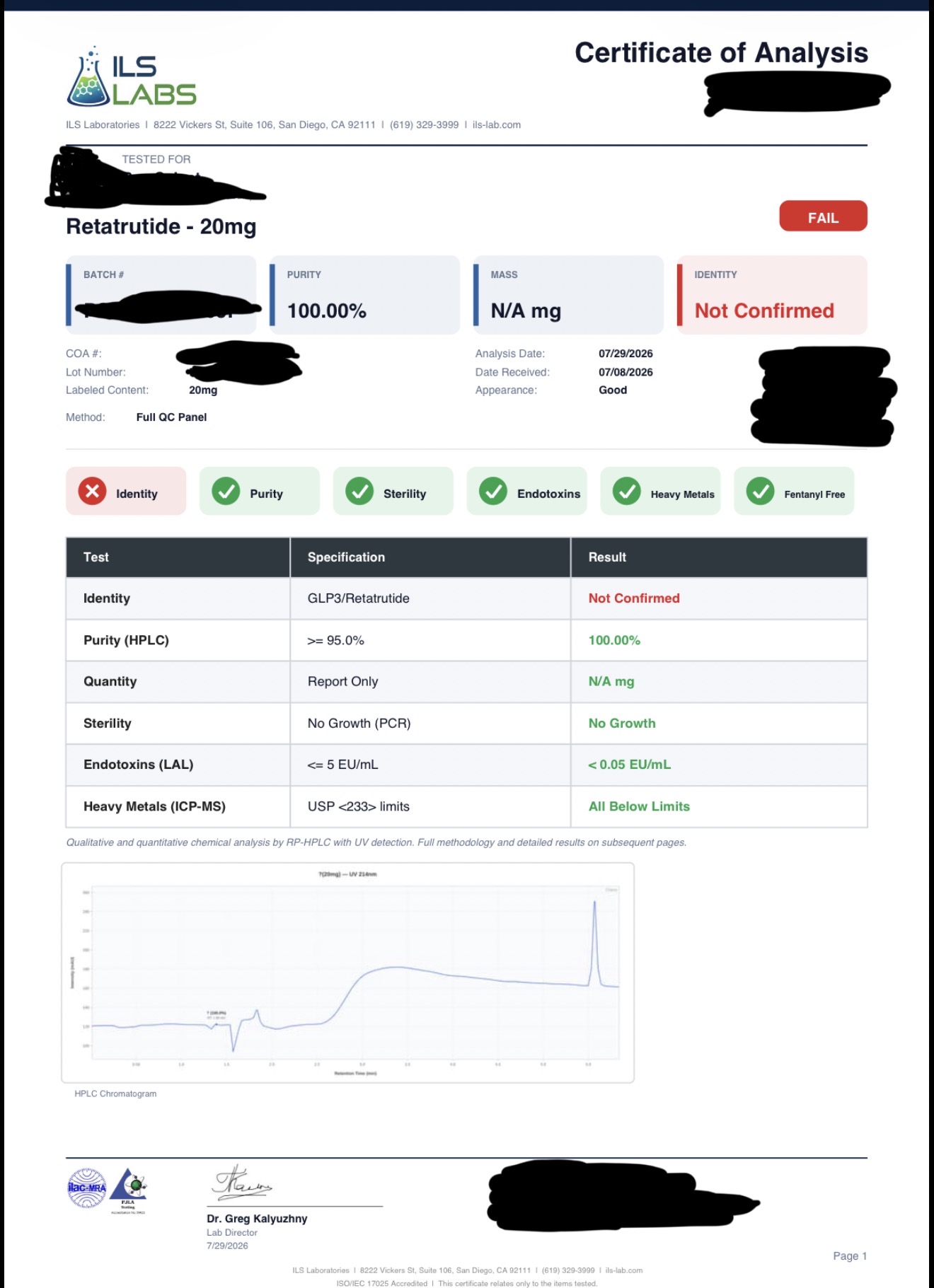
Someone has now sent us another ILS retatrutide certificate.
This one says:
Identity: Not Confirmed
Quantity: N/A mg
Overall Result: FAIL
Purity: 100.00%
What the fuck, guys?
ILS could not confirm that the material was retatrutide.
ILS could not report how many milligrams of retatrutide were present.
ILS failed the sample.
But whatever mystery substance was in that vial, ILS wants everyone to know it was absolutely flawless.
This is not a complicated disagreement about chromatographic methodology. This is a PDF arguing with itself in four adjacent boxes.
It is the analytical equivalent of:
Name: Unknown
Occupation: Unknown
Location: Unknown
Employee of the Month: Yes
We Know ILS Knows Better
Here is where this becomes especially embarrassing.
Last month, Peptide Critic sent ILS a blind control labeled SS-31. There was no peptide in it. We send controls like this to laboratories to see whether they actually catch a bogus sample.
ILS caught it.
Identity: Not Confirmed
Purity: N/A
Overall Result: FAIL
That was correct.
ILS saw a chromatographic signal, could not establish that it was SS-31, and properly refused to assign an SS-31 purity percentage.
Six days later, another sample failed identity and ILS gave it 100.00% purity.
So this is not a situation where ILS simply has no way to suppress the purity result. Their own certificate proves they know what “N/A” means.
They found the button.
They used the button.
Then six days later, they apparently lost the button and replaced it with a giant green participation trophy.
The PDF Is the Easy Part
There is an old idea that you can judge a restaurant by the condition of its bathroom. If the part customers can see is disgusting, you probably should not demand a tour of the kitchen.
A laboratory COA is the part customers can see.
Running analytical equipment, preparing samples, maintaining reference standards, reviewing integrations, matching accession numbers, and interpreting chromatograms are the complicated parts.
Writing down the conclusion without contradicting yourself is supposed to be the easy part.
Nobody needs a chemistry degree to notice that “Identity Not Confirmed” and “100.00% Purity” should not be presented together without a very clear explanation.
If ILS means that one unidentified peak represented 100% of the peak area it chose to count, then write that.
Do not put a giant green PURITY: 100.00% box on a failed retatrutide report and expect customers to understand that “purity” may actually mean “this mystery peak was very lonely.”
The certificate is the final product.
It is the document vendors publish, customers scan, and everyone relies upon to understand what the laboratory found.
If nobody at ILS can catch an obvious contradiction on page one, why should anyone automatically trust the invisible steps behind it?
The only thing customers receive is the PDF, and the PDF currently has the intellectual coherence of a drunk group chat.
Enough
At this point, I’m done with ILS. You should be too.
They look like a relic of the cannabis-testing industry trying to cash in on peptides. Maybe they are incompetent. Maybe they do not care. Maybe someone is taking bong rips between assays. Maybe it is all of the above. The result is the same: I do not trust their reporting.
Testing is the only real safeguard we have against dishonest manufacturers, distributors, and resellers. If a lab cannot accurately explain its own results on a one-page PDF, what good is the testing?
If a vendor uses ILS, question it. Ask for testing from another lab.
Otherwise, we might as well pin Uncle Wang’s toilet water mixed with random white powder from Tess on WhatsApp, because that is about the level of confidence ILS currently brings to the table.
The dog remains their most credible result.
This article critiques contradictions and quality-control failures visible in issued ILS certificates. It does not allege that the underlying chromatographic data were fabricated.
Community Discussion