
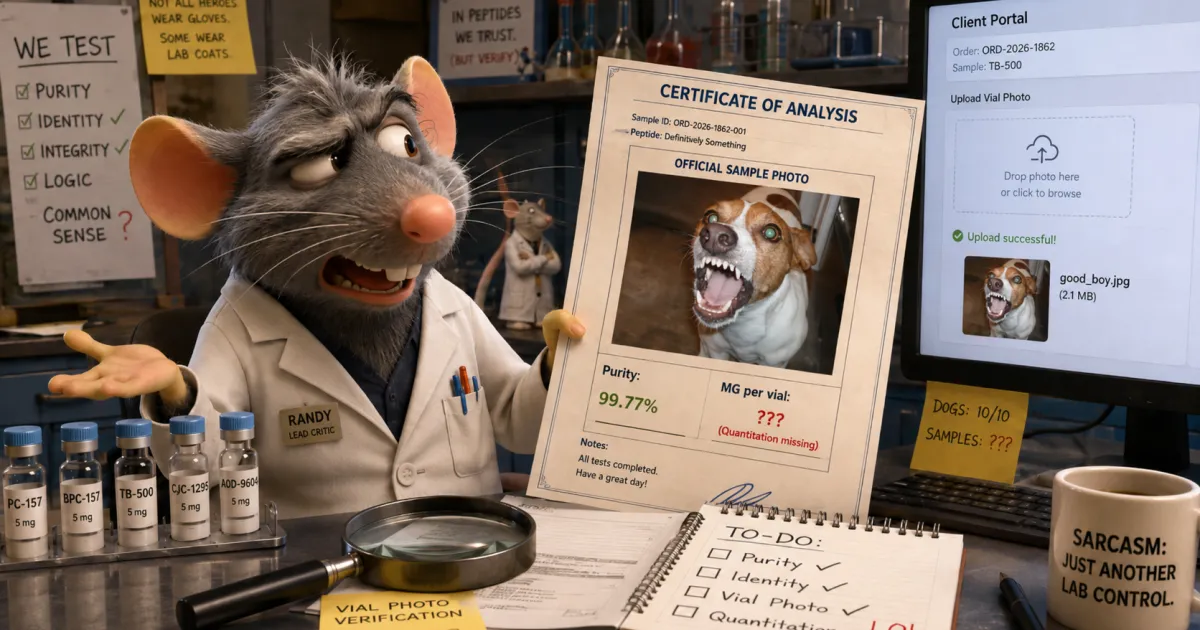
99.77% MOTS-C, 100% Good Boy: ILS Labs Issues a Certificate of Animalysis
Every time I think the peptide industry has reached peak stupid, somebody finds a taller mountain.
ILS Labs has been appearing more frequently on COAs from single-bottle vendors. That makes its procedures important because buyers are being asked to trust these certificates as evidence that the vial being sold is connected to the vial that was tested.
Then ILS announced an exciting new client-portal feature.
Customers can now upload vial photos at any point after placing an order, right up until the COA is finalized. According to the email:
“Photos will automatically appear on your Certificate of Analysis.”
“Automatically” should have been the first warning.
Apparently, the photo-quality-control checklist consists of:
- Does the file contain pixels?
- Fuck it, publish.
One of our top tier community members named Commander decided to find out exactly what ILS considered a “vial photo.”
They uploaded a picture of their dog Cujo.
Not a vial sitting beside a dog. Not a dog holding a vial. Not a blurry background image that a rushed reviewer could reasonably overlook.
Just a happy, unmistakable dog.
And ILS put him on the COA.
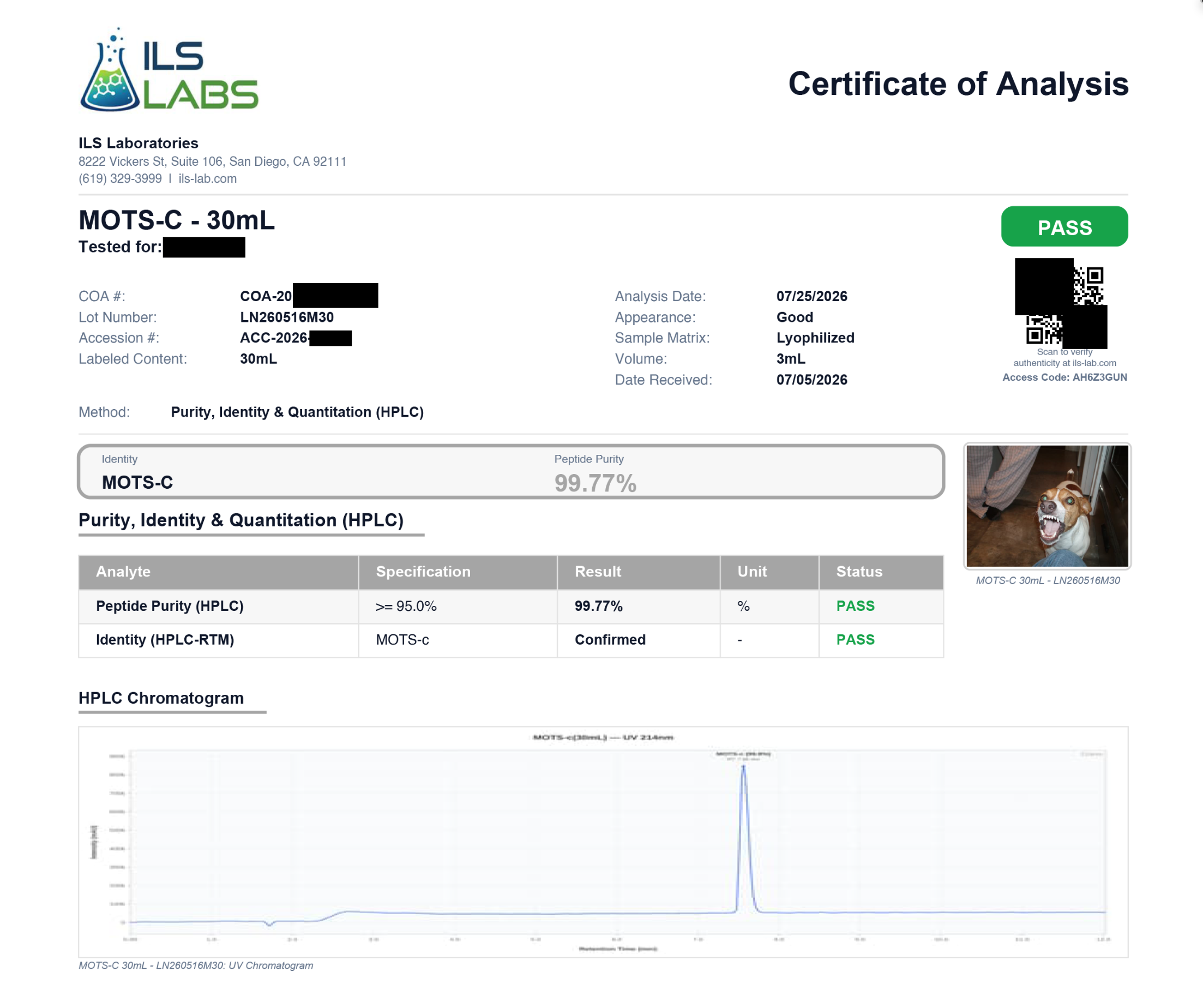
The finalized certificate identifies the sample as MOTS-C, marks it PASS, reports 99.77% peptide purity, and places the dog directly beside the results with the MOTS-C sample information underneath. The document was signed and issued by the lab director on July 25, 2026.
The page even lists the sample’s appearance as “Good.”
On that particular finding, ILS is beyond reproach. That is an exceptionally good-looking dog.
Congratulations, buddy.
Identity: MOTS-C
Species: Unclear
Purity: 99.77%
Good-boy content: Off the charts
What This Does and Does Not Prove
Let’s be precise here because ILS will probably try to hide behind precision after allowing a household pet onto a laboratory certificate.
This does not prove that ILS fabricated the chromatogram. They didn't.
It does not prove that the physical sample was switched. It wasn't.
What it proves is narrower, but still extremely serious:
A customer-controlled image, uploaded after the order was placed, was allowed onto a finalized COA without any effective review capable of noticing that it depicted a mammal instead of a vial.
The page-one image visibly shows the dog occupying the sample-photo position on the official certificate.
That means the photograph has no independent evidentiary value as a record of what ILS physically received.
It is not necessarily an intake photograph taken by laboratory staff. It is not proof that the pictured vial was accessioned, opened, sampled, or placed on an instrument.
In this case, it was customer best friend with a lot number underneath it.
Maybe ILS has immaculate internal intake photographs and pristine chain-of-custody records hidden inside its system. I sincerely hope it does.
Consumers cannot see those.
Consumers see the dog.
Why the Dog Actually Matters
In the single-bottle peptide market, buyers have very few public-facing ways to compare a vendor’s product with the sample represented on a COA.
One of the crude but useful checks is the physical presentation of the vial:
The cap color. The crimp. The stopper. The seal. The label. The lot information.
This is not CSI: Peptide Unit, but it can expose an obvious mismatch between what was supposedly tested and what customers actually receive.
ILS’s upload-anytime feature blows up that verification layer.
A customer can apparently submit a physical sample and then separately choose the photograph that will appear beside the results. A dishonest vendor could potentially send a known-good vial for testing and later upload a picture of a completely different product that they are selling.
We have not demonstrated that any vendor did that.
We have demonstrated that ILS’s system failed to distinguish a peptide vial from a dog.
That concern is no longer theoretical. Cujo is on page one.
ILS promotes its COAs as QR verified and says each certificate is tied to a specific sample with its own chain-of-custody and testing history. A QR code may verify that ILS issued the certificate. It cannot prove that a client-supplied photograph depicts the item ILS received.
In this case, scanning the code would simply authenticate that ILS officially published a dog.
A tamper-resistant document containing unverified customer input is still a document containing unverified customer input.
The PDF can be genuine while the photograph is meaningless.
The Quantitation That Wasn’t
The dog is funny.
The missing result is not.
The COA states that the method performed was:
“Purity, Identity & Quantitation (HPLC)”
The results table reports peptide purity at 99.77% and confirms the identity as MOTS-C.
What it does not report anywhere is the quantitative peptide content in milligrams per vial.
The short version is they forgot to input the detected weight of the peptide.
What ILS Needs to Fix
The solution is not complicated.
ILS should take its own intake photograph after receiving each sample, with the accession number physically visible in the frame. That photograph should be locked to the sample record and should be the only image presented as documentation of the tested item.
Any optional customer-uploaded image should be placed in a separate section and prominently marked:
CLIENT-SUPPLIED IMAGE. NOT TAKEN OR VERIFIED BY ILS LABS.
There also needs to be a basic human review before a photograph is attached to a finalized laboratory certificate. A dog, toaster, burrito, unrelated vial, or vacation photograph should not survive that process.
ILS should reissue this certificate (they will) and explain how the dog passed its final review.
These are not difficult questions.
One of them is literally:
Why is there a dog on the COA?
Our Position
Until ILS fixes or properly explains this feature, I would not treat the photograph on an ILS COA as evidence that the pictured vial is the vial the laboratory received and tested.
Treat it as customer-supplied decorative material.
I also would not consider an ILS report labeled “Purity, Identity & Quantitation” complete unless it contains an actual quantitative content result.
ILS has successfully verified three things:
- The chromatogram contains a peak.
- The client portal accepts JPEGs.
- Cujo is a very good boy.
The vial-to-photo connection remains unverified, and the milligrams remain missing.
Final Results
MOTS-C purity: 99.77%
Dog purity: 100%
Photo verification: FAIL
Quantitation: NOT DETECTED
Good boy: PASS
The dog passes.
The process does not.
Community Discussion