
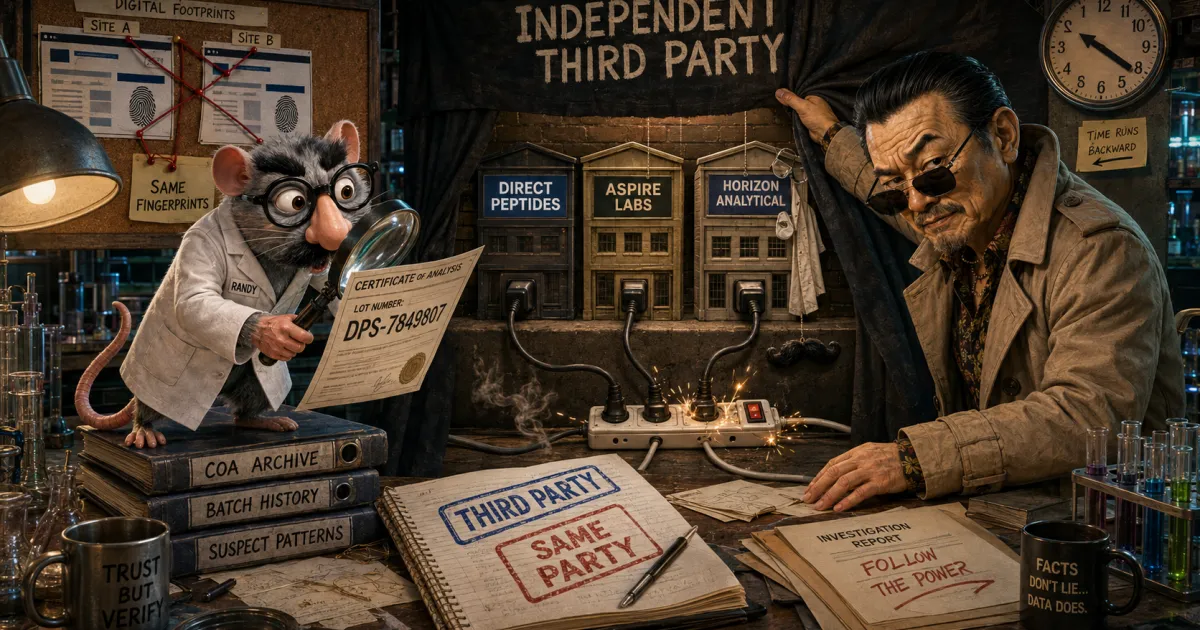
Horizon Analytical and the Case of the Missing Third Party
Direct Peptides says its products are “US-made, third-party batch tested.” That is exactly the sort of sentence designed to make customers feel reassured and stop asking questions.
Unfortunately, we kept asking.
Public records tie Aspire Labs to Direct Peptides. Aspire’s own recruitment materials also describe its role in building and directing Horizon Analytical’s laboratory operation. Horizon is the company named on certificates Direct Peptides uses to support its third-party testing claim.
So, before we get buried in corporate names, job advertisements and COA fine print, there is one very simple question:
If Aspire has a hand in the company selling the peptide and the operation certifying it, who exactly is the third party?
The Aspire–Direct connection is public
We do not need a leaked memo, an anonymous source or a woman whispering “investor materials” from behind a paywall.
The USPTO lists Aspire Labs as the applicant for the DIRECT PEPTIDES trademark. USPTO record
Avery Wiese publicly describes himself as “President at Aspire Labs” and links directly to directpeptides.com. Avery Wiese’s profile
A verified portfolio entry for work on the Direct Peptides website identifies Avery Wiese as the collaborator and Aspire Labs as the client. Direct Peptides website project
Aspire is behind Direct Peptides.
Receipt. Receipt. Receipt.
Now let us stroll over to the laboratory side of this mess.
Aspire is building Horizon’s laboratory
An Aspire Labs job advertisement says:
“Horizon Analytical is launching as a third-party analytical testing service for lyophilized peptide products in the RUO market.”
The phrasing is already odd because Horizon is not some unborn startup waiting for a ribbon-cutting ceremony. It already has a website, portal, clients and certificates.
The rest of the advertisement reveals what is apparently still being launched or expanded: Horizon’s physical laboratory operation.
Aspire says Horizon is arranging immediate testing capacity through a partner laboratory while building “our own in-house analytical lab” over the next six to twelve months. Aspire Labs job advertisement
“Our.”
Such a tiny word. Such a large problem.
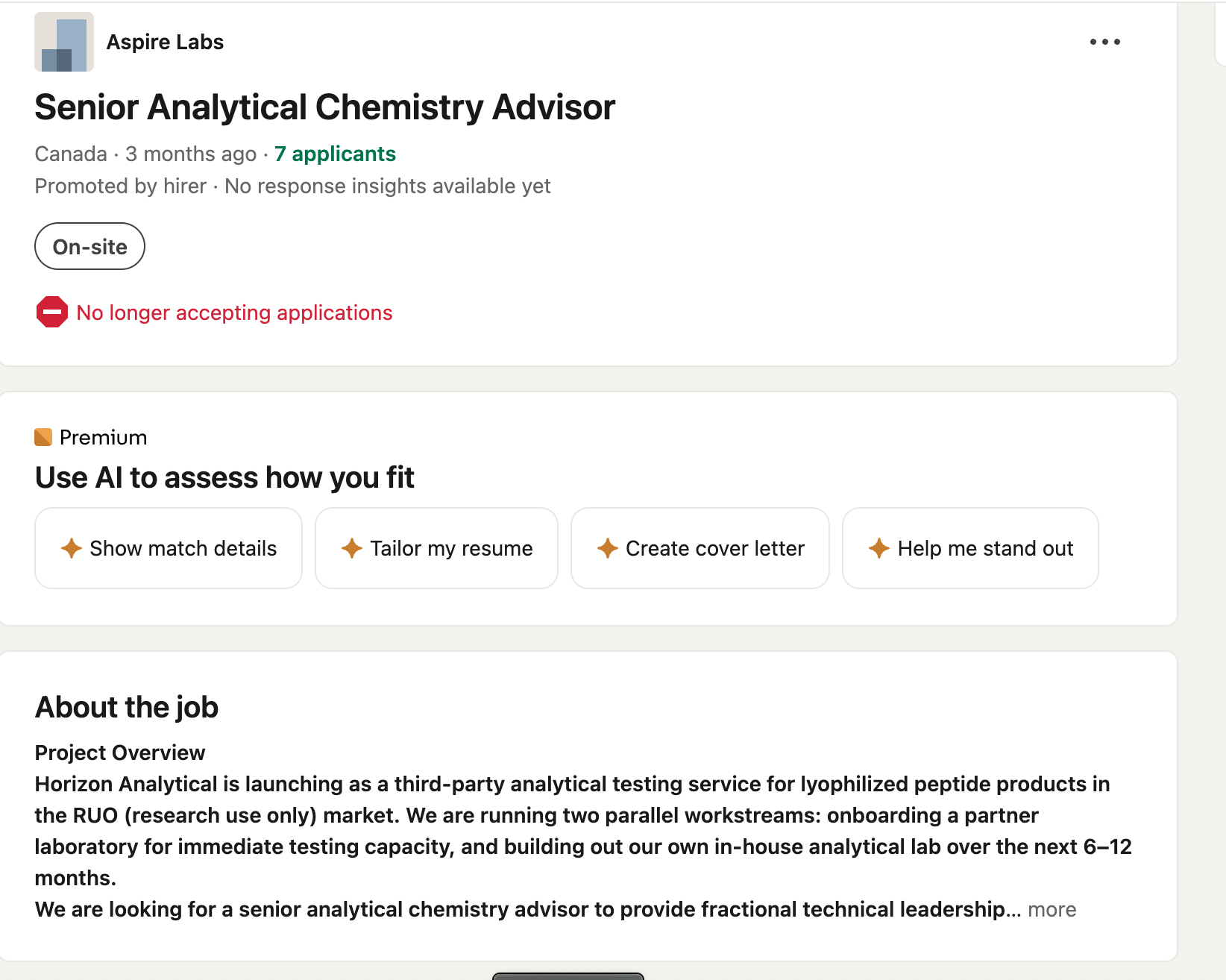
Horizon exists. Its own laboratory apparently does not.
This is the especially ridiculous part.
Horizon has already issued branded certificates for Direct Peptides. Public examples date back to at least December 2025. Example Horizon certificate
Horizon’s website claims “PhD-Verified Accuracy” and says it is “Trusted by 300+ clients globally.” Horizon Analytical
Yet Aspire’s recruitment post says Horizon is relying on a partner laboratory for immediate capacity while its own in-house facility is built.
So who physically performed the Horizon-branded tests already sitting on vendor websites?
Name the lab.
This does not have to be sinister. Contract laboratories perform work for other laboratories all the time. The scandal is not necessarily the outsourcing. The scandal is expecting customers to treat the result as transparent and independent while keeping the actual performing laboratory offstage like an understudy nobody is allowed to meet.
The certificates we reviewed identify Horizon. They do not clearly tell customers which partner laboratory operated the instruments, whose quality system governed the analysis or how that laboratory relates to Aspire.
So the product comes from Direct Peptides, the certificate comes from Horizon, Aspire is involved with both, and some unnamed partner may be doing the actual chemistry.
That is not transparency.
That is a shell game with chromatograms.
The website had already told on them
Before Aspire posted the job advertisement, Horizon’s own website was already dropping clues like a drunk suspect in a detective show.
Its homepage contains a mock administrative dashboard showing lot number DPS-7849807.
Direct Peptides uses the same DPS-####### format throughout its actual batches. A July 2026 Horizon certificate for Direct Peptides, for example, uses lot DPS-3402861. Horizon certificate
Why is the supposedly outside laboratory using Direct Peptides-style batch data in its sales demo?
Given that Aspire is building Horizon’s laboratory operation, the answer is practically waving from the balcony.
Both websites also run on Framer. They share some design fingerprints and contain the same strangely specific internal layer name: Frame 427322079.
They are not clones. The sites have different project IDs, analytics accounts, fonts, breakpoints and design tokens. Framer alone proves nothing.
But Framer no longer has to carry the case in six-inch heels.
Aspire’s own job posting proves the operational relationship. The websites are simply supporting evidence—and, frankly, a little comic relief.
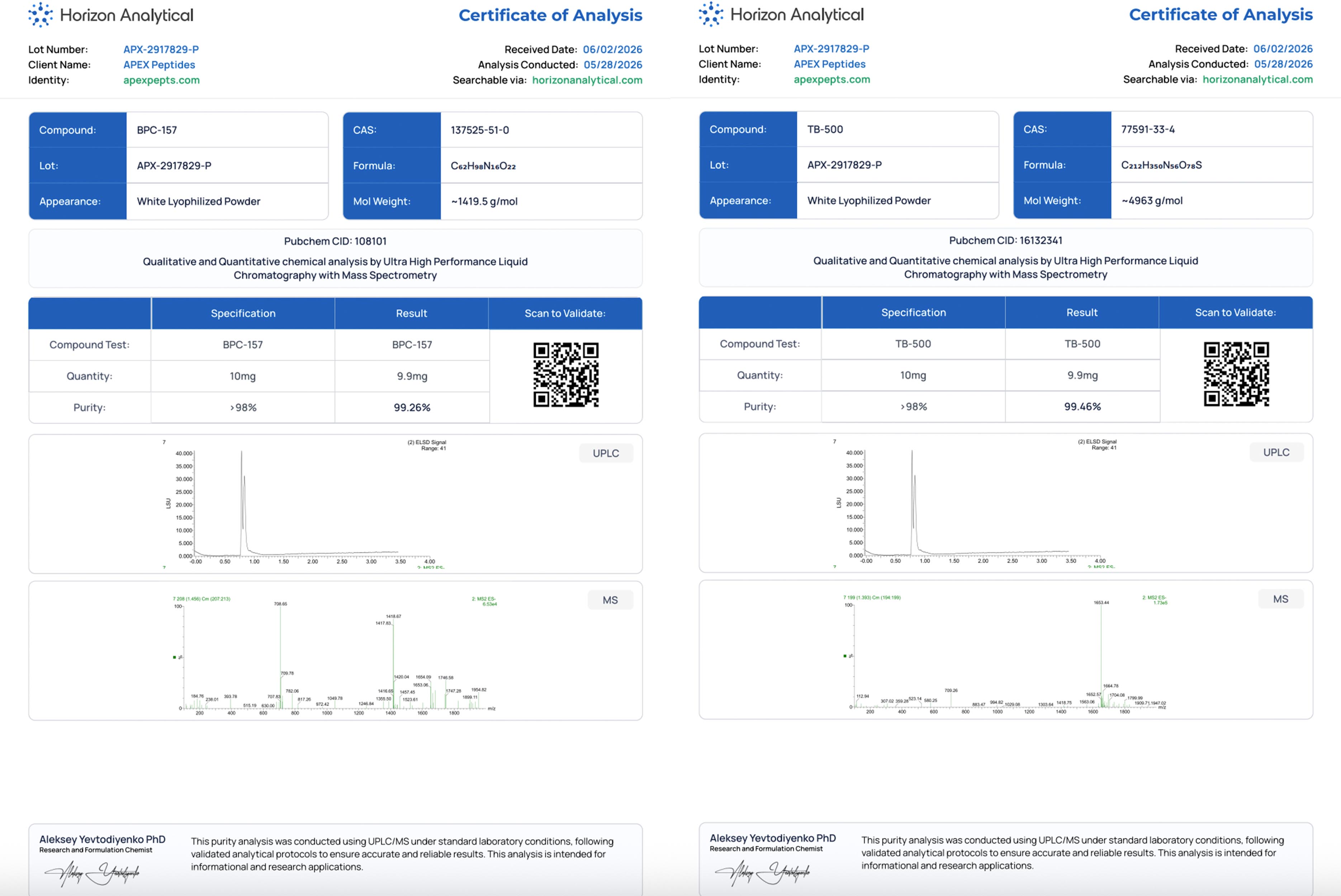
The certificates could use a DeLorean
As if the ownership and independence problem were not enough, multiple Horizon certificates also contain dates that do not work.
Events appear in an order that would require samples to travel backward through time.
One bad date might be a typo. More than one starts looking like nobody was checking the paperwork before issuing official reports.
Does that automatically prove the instrument data is fake? No.
Does it make the certificate look sloppy and undermine confidence in the laboratory’s document controls? Absolutely.
Dates, sample identity, lot numbers and chain-of-custody records are what connect an analytical result to the product customers are actually buying.
Without that documentation, a purity result is just a number wearing a lab coat and demanding to be addressed as “Doctor.”
If Horizon wants the public to trust its certificates, the certificates should obey linear time.
The bar is in hell, and somehow we are still limbo dancing.
What we relied on
Earlier reports raised questions about a shared address and investor materials describing at-cost certificates. We could not independently verify those details, so they are not part of our conclusion.
They do not need to be. The USPTO record, Avery Wiese’s public profile, the verified Direct Peptides design project, Aspire’s Horizon recruitment advertisement, Horizon’s certificates and both companies’ websites provide stronger evidence readers can inspect themselves.
That is enough. No mystery memo required.
Every Horizon certificate now comes with questions
Aspire Labs is behind Direct Peptides and is also building and directing Horizon’s laboratory operation. That puts Aspire on both sides of Direct Peptides’ “third-party tested” claim.
A separate company name does not create independence when the same organization is involved with both the product and the testing layer. And if an unnamed partner laboratory actually performs the analysis, identify it, put its name on the certificate and disclose the chain of custody.
This also casts doubt beyond Direct Peptides.
It does not prove that every Horizon result is wrong or that every vendor using Horizon has the same relationship. But if Horizon is this entangled with one vendor, customers deserve to know what other financial or operational arrangements it has made—and with whom.
Until Horizon discloses its ownership, partner laboratory and vendor relationships, every company relying on its certificates should face additional scrutiny. A Horizon logo may indicate that some analysis occurred. It does not, by itself, prove independent third-party testing.
Direct Peptides says “third-party batch tested.” Direct Peptides
Aspire Labs appears to be standing behind both the vendor and the verifier.
That is not an independent referee. That is vertical integration wearing a fake mustache.
Please be serious.
Community Discussion