
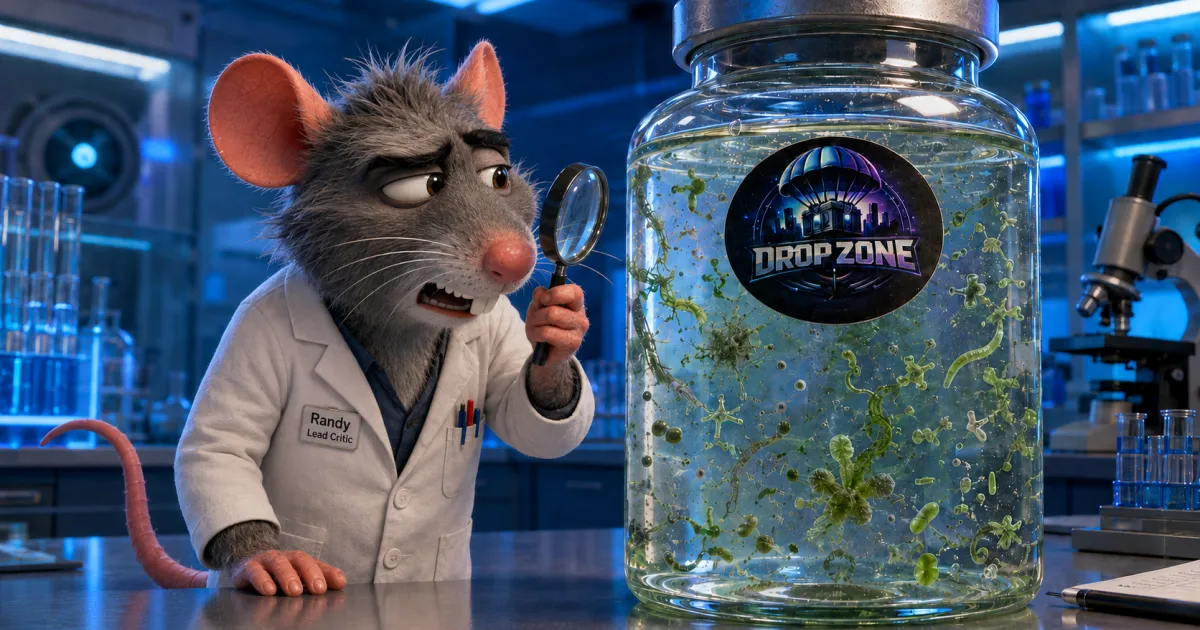
The Group Buy Problem: One Vial Passed. Others Started Growing Things.
On paper, a peptide group buy sounds almost too simple to screw up.
Someone collects preorders until the group reaches a minimum order quantity. Buyers usually pay through PayPal or crypto. The organizer sends the money to a supplier or reseller in China. The shipment arrives, a vial or two gets sent for testing, and the rest is labeled, packed and mailed to buyers.
Everyone saves 20% to 40%. The organizer makes a little money. Sometimes you even get stickers, a thank-you card and a crooked label fresh from somebody else's Niimbot.
It is like buying your peptides on Etsy, except Etsy may have better customer service.
The part left out of the sales pitch is that the entire system depends on a chain of trust that is usually held together by a Telegram username, a kitchen counter and a person who has no practical control over the factory, the Chinese reseller or what happens after the one test vial leaves the box.
Drop Zone's bacteriostatic water is a useful example of how that can go wrong even when the organizer appears to do the thing buyers were promised.
One Vial Really Did Pass
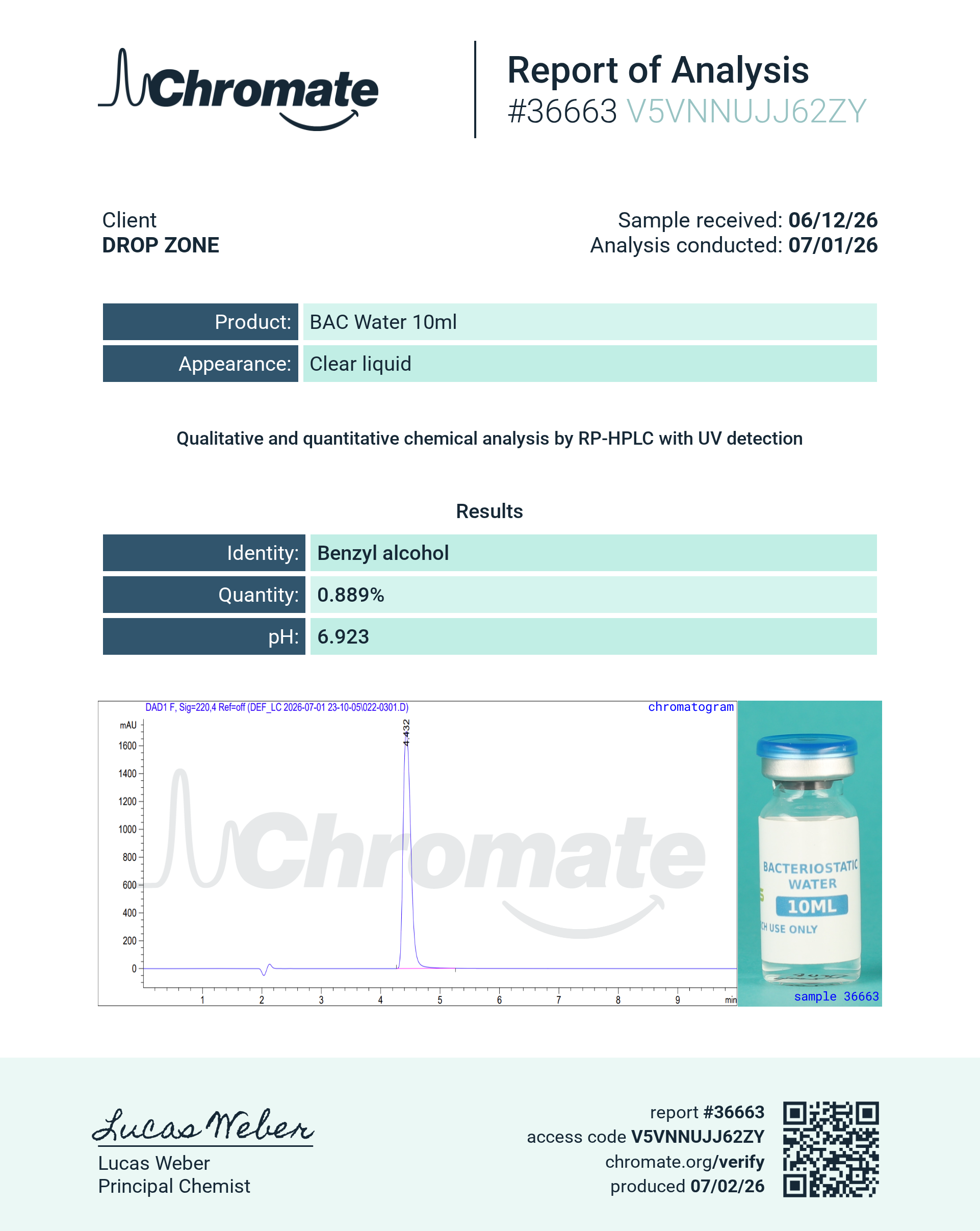
Drop Zone, a group buy run by "Kels", submitted a 10 mL vial of bacteriostatic water to Chromate for analysis.
The result looked good:
- Benzyl alcohol identity confirmed
- Benzyl alcohol measured at 0.889%
- pH measured at 6.923
- Appearance recorded as a clear liquid
That 0.889% result is essentially consistent with a product labeled as containing 0.9% benzyl alcohol. Standard bacteriostatic water is sterile water containing an antimicrobial preservative, commonly 0.9% benzyl alcohol.
So the report did its job. The problem is what the report does not say.
It does not prove that every vial in the shipment contained 0.889% benzyl alcohol. It does not prove every vial came from the same fill or lot. It does not establish a documented chain of custody between the bulk shipment, the vial selected for testing and the vials mailed to customers. Most importantly, this was a chemical analysis for benzyl alcohol and pH. It was not a sterility test.
A passing report follows the sample that was tested. It does not magically attach itself to every similar-looking vial in a cardboard box.
Then the Product Reached Buyers
Photos supplied to Peptide Critic show visible material inside other vials from the Drop Zone supply that buyers have described as algae-like.
We cannot identify that material from a photograph. It could be microbial growth, fungal growth, a biofilm, foreign particulate or something else. Calling it algae is a visual description, not a laboratory conclusion. Whatever it is, visible foreign material does not belong in a vial represented as bacteriostatic water.
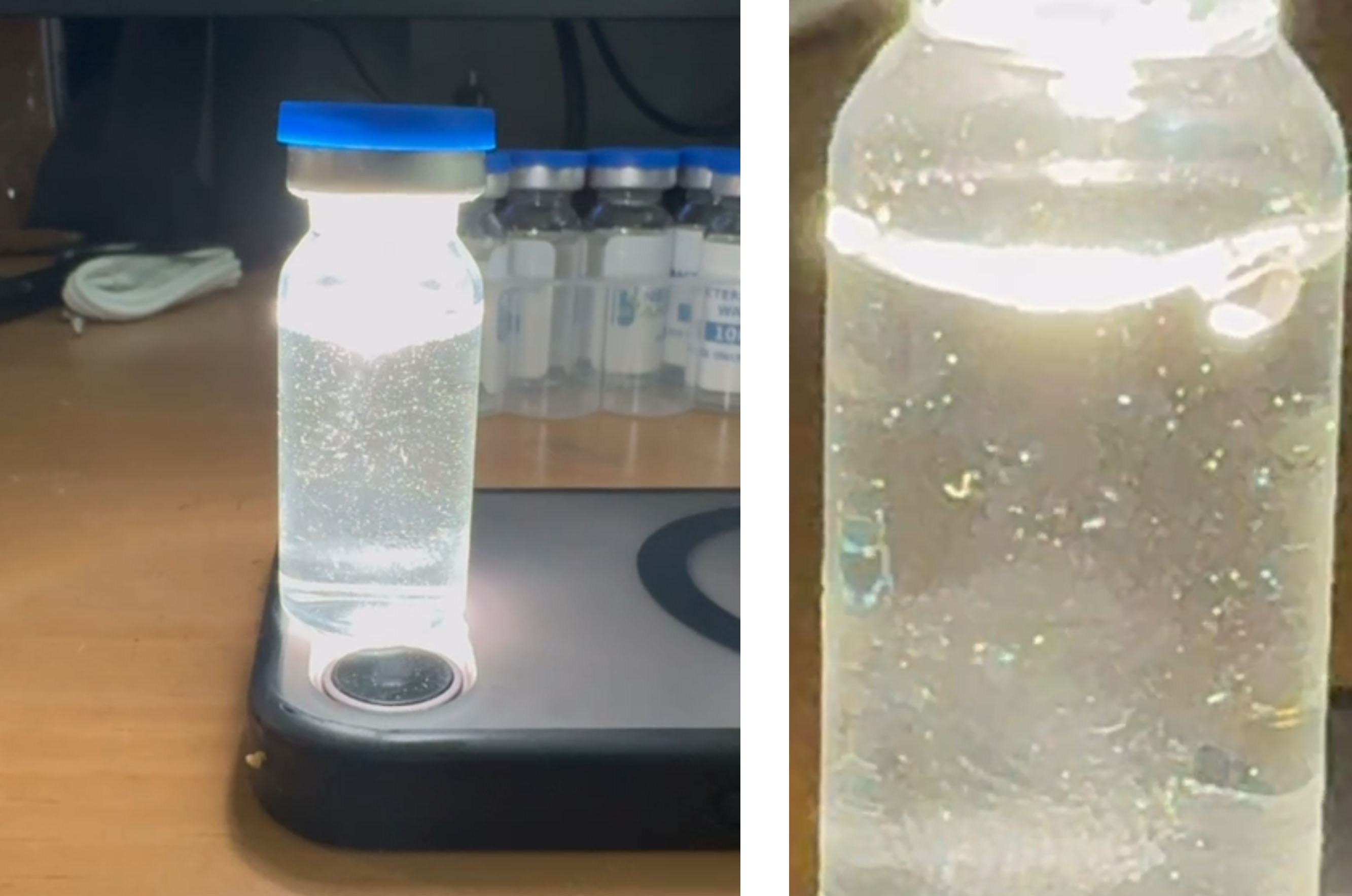
Photos supplied to Peptide Critic show visible foreign material in vials tied to the Drop Zone supply. The material has not been identified by microbial testing.
The official labeling for approved Bacteriostatic Water for Injection instructs users not to use the product unless the solution is clear and the seal is intact. That is not a subtle quality-control standard. If something appears to be growing in the vial, the correct number of additional tests to perform before using it is zero. Do not use it.
How Can a Passing Sample and Bad Vials Both Exist?
There are several possibilities. The tested vial may have come from a different fill or lot. The MFG may have combined inventory from more than one source. Some vials may have been filled or sealed incorrectly. Product could have been substituted after the sample was selected. Storage or handling could have compromised part of the shipment. The test vial may simply have been good while other vials were not.
We do not currently have evidence establishing which of those occurred. That is exactly the point.
Group-buy buyers are rarely shown a manufacturing record, fill record, lot reconciliation or documented chain of custody. They see a photo of boxes, a payment screenshot and a COA. Then they assume all three refer to the same product.
Sometimes they do. Sometimes one vial passed while whatever arrived at your house is apparently trying to photosynthesize.
The Group-Buy Organizer Is Still a Reseller
Group buys are often presented as a community service, but the people running them typically add roughly 20% to 30% to their cost. That does not automatically make them dishonest. Receiving thousands of vials, arranging testing, printing labels, packing orders and dealing with buyers is real work.
It does make them a reseller.
The organizer is usually buying from another reseller in China, not standing on the production floor watching the vials get filled. They are trusting the person who made the deal, who may be trusting a factory, which may be subcontracting part of the order somewhere else. Every added hand creates another opportunity for a lot to be mixed, substituted, mishandled or mislabeled.
And when something goes wrong, the friendly group-buy organizer has limited leverage. If the Chinese reseller refunds or replaces the batch, buyers may eventually be made whole. If the reseller says the sample passed and tells the organizer to kick rocks, the organizer either has to personally absorb the loss or pass the rock-kicking down the chain.
Guess who is standing at the bottom of that chain.
Crypto offers no chargeback. PayPal Friends and Family is not buyer protection. A Telegram apology does not replace contaminated product. The fact that the organizer is a nice person, a busy mom or very active in the community does not create a quality system on the kitchen counter.
The NAD Vials Raise the Same Question
The Drop Zone NAD group buy presents a second, separate consistency problem.
Photos show multiple vials being reconstituted under the same general conditions, but the solutions drawn into clear syringes do not look the same. One appears nearly colorless. Others range from yellow to dark amber or reddish brown. The amber glass vials can distort appearance, but the clear syringes make the difference difficult to dismiss.
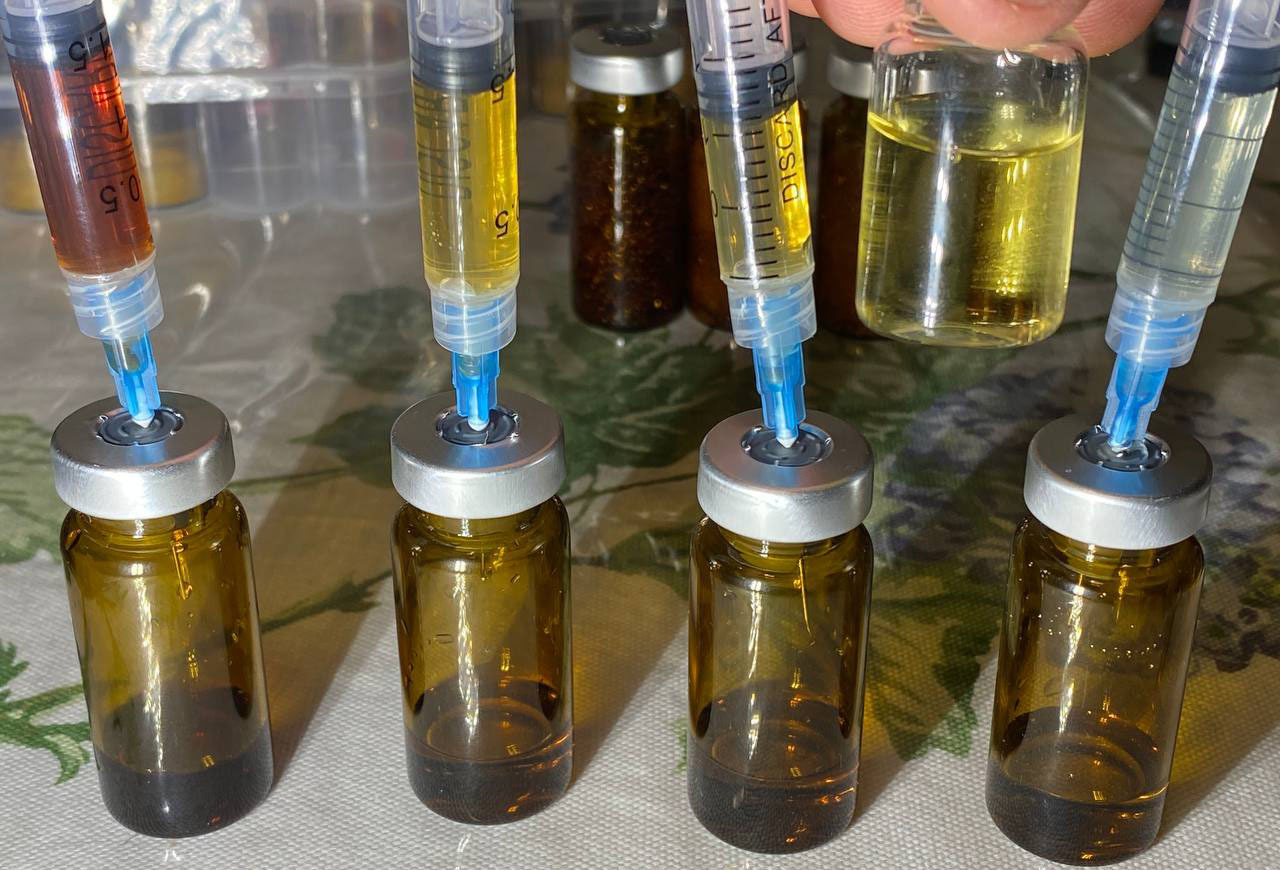
Reconstituted NAD from the group buy shows materially different colors in clear syringes, ranging from nearly colorless to dark amber.
High-quality beta-NAD dissolved in water is generally described by laboratory suppliers as clear and colorless to very faint yellow. A dark amber solution is not what buyers should expect from apparently identical vials.
Oxidation has been suggested as an explanation, but color alone cannot establish that. NAD+ is already the oxidized member of the NAD+/NADH redox pair. The discoloration could reflect degradation, impurities, a concentration difference, pH differences, storage conditions, light exposure, different raw material or a completely different lot. It needs comparative testing, not a group-chat guess.
The useful test would be to send both a clear vial and a dark vial for identity, purity and content analysis, ideally with pH and appropriate degradation-product screening. Sterility and endotoxin testing would answer different questions and should not be confused with chemical identity or purity.
Again, the problem is not merely that one vial looks ugly. It is that products represented as one batch are behaving as if they may not be one consistent product.
Batch-Specific Testing Requires More Than a Batch-Specific PDF
People love the phrase "batch-specific testing." It sounds reassuring. It is also meaningless unless the tested sample can be reliably connected to every vial sold under that result.
A credible process should answer basic questions:
- Was the sample selected randomly after the entire shipment arrived?
- Was it taken from the same sealed lot distributed to buyers?
- Did every shipped vial carry a lot identifier tied to the report?
- Was the supplier prevented from choosing a special test sample?
- Were identity, purity, quantity, sterility and endotoxin tested where relevant?
- Is there a written refund or replacement policy if the received lot fails?
- Who absorbs the loss if the overseas reseller refuses?
If nobody can answer those questions, you do not have batch-specific testing. You have a PDF sitting next to a pile of vials.
Is Saving 20% to 40% Worth It?
For us, no.
Established vendors can fail too. We document those failures constantly. A retail website and a logo do not make a supply chain safe. But an established seller at least has inventory ownership, a public reputation, repeat customers and a stronger incentive to replace and never sell a bad lot. A group buy often gives you the same overseas sourcing risk with less accountability, weaker buyer protection and fulfillment taking place on somebody's spare workbench.
The stickers are not quality control. The thank-you card is not chain of custody. The Niimbot label is not a lot record. And a passing result from one vial does not tell you what is in yours.
Drop Zone appears to have tested a sample of its bacteriostatic water, and that sample passed the limited chemical analysis performed. That deserves to be stated clearly. It also does nothing to explain visible foreign material in other vials or NAD products with dramatically different appearances after reconstitution.
That is the group-buy problem in one sentence: you are not only trusting the product. You are trusting every stranger between a reseller in China and a shipping label printed on a kitchen counter.
Twenty percent off is not much of a bargain when the vial comes with its own ecosystem.
Peptide Critic will review any lot-matched testing, chain-of-custody documentation, sterility results or supplier records provided by Nexus Aminos, Drop Zone or Kelsie Aziz and will update this article if that evidence materially changes the findings.
Community Discussion