

Just Add Logo: Inside the White-Label Peptide Machine
The peptide space has a trust problem, and it starts with a PDF.
Anyone who has spent five minutes around research peptides has seen it. You message “Jenny” on WhatsApp, ask about a compound, and she immediately sends back a lab test. There is a purity number. There is a batch number. There is usually a logo from a lab people recognize.
And a lot of people stop right there.
They see a COA and assume the product is tested.
That is the mistake.
A COA does not automatically prove that the vial in your hand came from the tested batch. It does not prove chain of custody. It does not prove the seller commissioned the test. It does not prove the seller rejected failed material. It does not prove the sample tested was representative of the inventory being sold. It does not prove proper storage, proper fulfillment, sterility, or accountability.
At best, it proves that some sample, submitted by someone, produced the result shown on that document.
That is the “Jenny” problem.
The bigger issue is that the exact same trust gap is now being dressed up with cleaner websites, nicer labels, and white-label peptide programs.
When someone buys one bottle from a retail research peptide vendor, they are paying a premium. That premium is supposed to mean something.
The whole argument for paying more is that the vendor is doing the work the buyer is not doing. A real vendor should be sourcing carefully, receiving product directly, testing actual lots, matching COAs to inventory, controlling storage, controlling fulfillment, rejecting bad product, and taking responsibility when something goes wrong.
That is the difference between buying from a retail vendor and buying from a random overseas reseller.
You are not paying more because the powder magically costs more.
You are paying more because someone is supposed to be absorbing the risk, doing the verification, and standing behind the product.
But if a “vendor” is really just a brand layered on top of someone else’s inventory, someone else’s testing, someone else’s fulfillment, and someone else’s backend, the premium starts looking very different.
At that point, the customer may not be paying for independent quality control.
They may just be paying for packaging.

White Labeling Turns the WhatsApp Problem Into a Storefront
White labeling is not automatically a scam. There are legitimate white-label businesses in plenty of industries. But peptides are not coffee mugs.
In this market, the entire trust structure depends on whether the product in the vial can be tied back to real testing, real custody, real handling, and real accountability.
A white-label peptide brand can look like a full vendor from the outside. It can have a logo, a catalog, a checkout page, product descriptions, disclaimers, branded labels, and a COA library. To the average buyer, that looks like a company selling tested research peptides.
But behind the scenes, that brand may not be sourcing the material, testing the material, receiving the material, labeling the vial, packing the order, or shipping the product.
That is where the trust problem begins.
Because when the brand is only the marketing layer, the COA becomes a borrowed credential. It is not proof of that brand’s quality control. It is proof that the brand had access to a document.
That is COA laundering.

AlphaBioMed Shows the Model Is Spreading
This is not just one company.
AlphaBioMed publicly offers a white-label/private-label intake process for businesses that want to offer AlphaBioMed products under their own brand.
That matters because it shows the model is not theoretical. White-label peptides are becoming a category.
AlphaBioMed is at least more direct about what appears to be happening: another business can offer AlphaBioMed products under its own brand. That is still worth scrutiny, but it is easier for buyers to understand the core issue. The name on the bottle may not be the company doing the sourcing, testing, or fulfillment.
That is the point.
White labeling does not just create new peptide vendors. It creates new peptide brands that may not function like vendors at all.

Your Peptide Brand Is the Clearest Case Study
Your Peptide Brand, or YPB, is the cleanest example of the problem because the public pitch is almost too perfect.
The homepage markets a turnkey white-label and dropship peptide business. It says users can launch their own research peptide brand with zero inventory risk. It advertises COA testing, verified purity, USA-based fulfillment, and says YPB handles manufacturing, fulfillment, and compliance while the brand owner focuses on profits.
That is not subtle.
It is a peptide business-in-a-box.
To someone trying to enter the space, it sounds amazing. No inventory. No warehouse. No minimums. No operational headaches. Just pick products, add your branding, and start selling.
To buyers, though, it should sound like a warning siren.
Because every layer of operational distance creates another trust gap.
The more the brand owner is separated from the physical product, the more important it becomes to know who actually controls the product. Who sourced it. Who tested it. Who selected the sample. Who received the lot. Who stored it. Who packed it. Who shipped it. Who handles a failed batch. Who is responsible when the COA does not match the vial.
YPB’s own terms make that gap hard to ignore.
The marketing page sells confidence. It says YPB handles manufacturing, fulfillment, and compliance.
The legal page says something much narrower. YPB’s terms say YPB does not sell, invoice, fulfill, or ship physical products, chemicals, or research-use materials. The terms say those activities are conducted by Drop Ship Consultants LLC through its own platform and payment processor. They also say YPB’s role is limited to brand infrastructure, educational resources, and digital access tools.
That is the story.
The front page sells the dream.
The terms relocate the responsibility.

Who Is Behind Your Peptide Brand?
Before talking about Ben Morgan, the connection needs to be established.
The Better Business Bureau profile for Your Peptide Brand, LLC lists the company in Duluth, Georgia. It lists a business start date of July 18, 2025 and an incorporation date of July 29, 2025. It also lists Benjamin Morgan as CEO and customer contact for the business.
So Ben Morgan is not being dragged into this randomly.
Public business records connect him directly to Your Peptide Brand.
That context matters because YPB is not just selling peptides. It is selling a system for other people to launch peptide brands.
And Morgan’s public background lines up almost perfectly with that model.
His own public bio describes him as an entrepreneur who started in pest control sales, worked through door-to-door pest control companies, co-founded Anthem Pest Control, and later became CEO of Rocktomic Labs. Rocktomic is described as a supplement company focused on private-label brands, and Morgan has publicly described the model as private-label dropshipping built for scale.
That is not a random résumé note.
It is the missing context for understanding YPB.
Your Peptide Brand does not present like a traditional lab-first peptide vendor. It presents like a private-label sales and fulfillment machine: pick the products, add your branding, launch the site, and let the backend handle the messy parts.
Morgan’s background is relevant because it shows a pattern of building scalable sales and private-label systems.
That model may make sense for supplements.
It becomes much more concerning when applied to research peptides.
A lab-first vendor asks, “How do we prove this product is what we say it is?”
A sales-first white-label platform asks, “How do we help more people sell this product under their own brand?”
Those are very different incentives.
And in peptides, incentives matter.

Then YPB Invented a Lab Coat
And this is where Your Peptide Brand goes from “questionable white-label model” to “please stop touching the lab paperwork.”
YPB did not just post an AFI test result.
They created a separate "Purity Analytics" certificate system, used AI to generate new COAs from AFI’s underlying results, and presented Analytical Formulations, Inc. as the performing lab without AFI’s permission.
AFI asked them to stop.
YPB kept using the lab’s name anyway.
That is not transparency. That is not third-party testing. That is not a better COA system.
That is a vendor-controlled PDF machine wearing someone else’s lab coat.
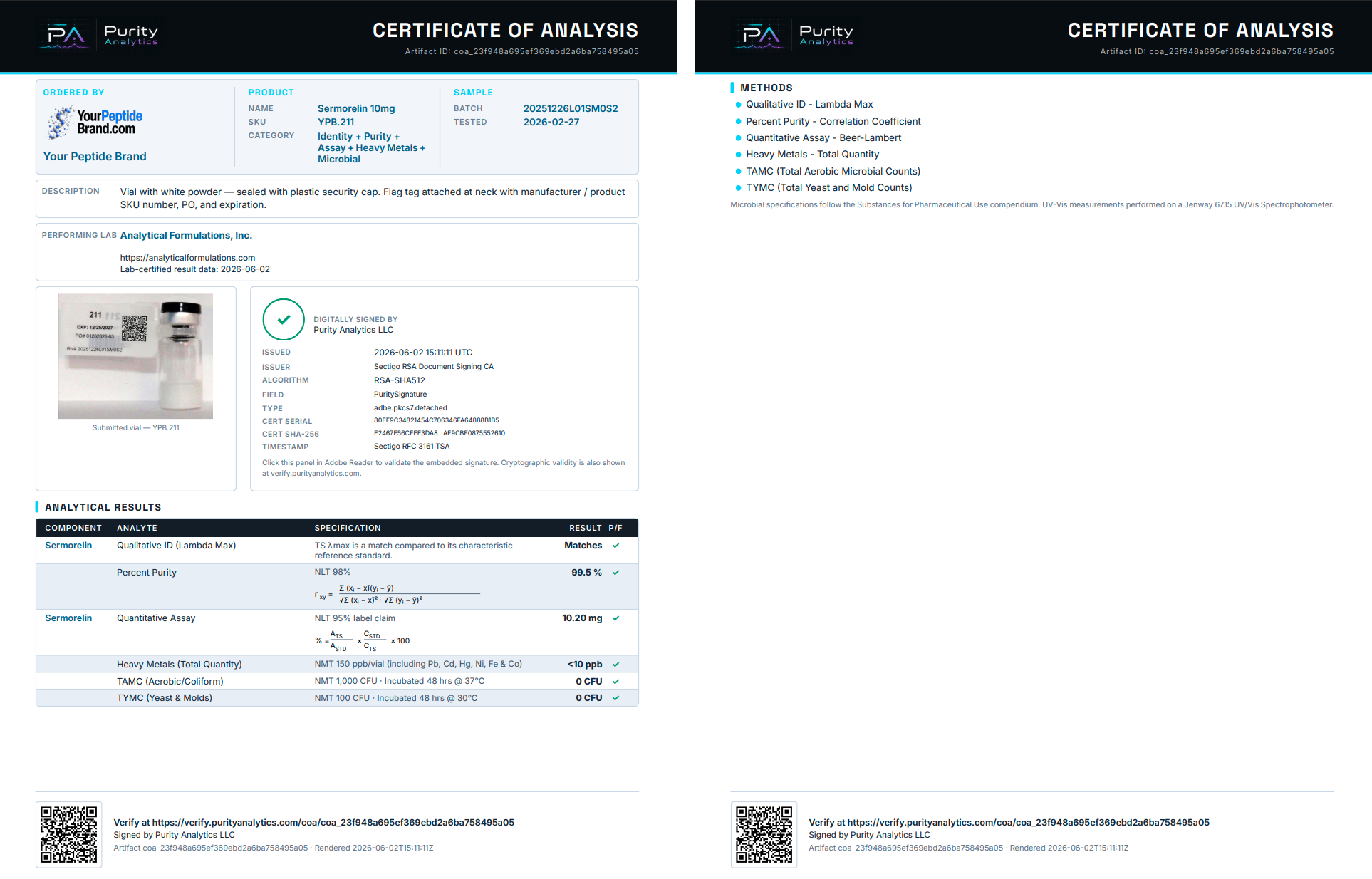
The attached example shows the problem clearly. The document is not an original AFI-native report. It is a Purity Analytics “Certificate of Analysis” listing Your Peptide Brand as the ordering party, Analytical Formulations, Inc. as the “performing lab”, and Purity Analytics LLC as the digital signer.
That matters because Purity Analytics is not AFI. Purity Analytics is not a lab. Purity Analytics is not real. They don't have the ability to run tests.
AFI is the actual testing lab. Purity Analytics is YPB’s fake verification wrapper — a separate certificate layer built to repackage AFI’s work into something that looks cleaner, shinier, and more vendor-controlled.
That is the white-label peptide problem in miniature.
The real work happens somewhere else. The trust gets borrowed. The branding gets polished. The customer sees the lab name and assumes the whole thing is legitimate.
But AFI did not sign up to be YPB’s credibility rental.
And good for AFI for not putting up with it.
In a space where lab names get passed around like Telegram coupon codes, a real lab drawing a hard line is exactly what should happen. If a vendor wants to use a lab’s name to sell trust, the lab should control how its work is represented. You do not get to take someone else’s analytical data, run it through an AI slop cannon, slap your own certificate branding on it, publish their address, and pretend that is quality control.
The best part is that YPB’s own generated certificate undercuts the entire stunt.
The disclaimer says the performing lab’s role is limited to testing or reporting the submitted sample. It says the lab does not manufacture, package, relabel, market, distribute, or sell the product. It says chain of custody from the manufacturer, customer, distributor, or upstream party is not certified unless expressly stated. It also says the report should not be used to imply approval, endorsement, safety, efficacy, legality, or suitability.
Translation: AFI tested a sample. AFI did not bless the vending machine.
That is the key point buyers need to understand.
A lab name on a PDF does not mean the lab endorses the vendor. It does not mean the lab approved the certificate format. It does not mean the lab authorized the use of its name in a vendor-controlled verification portal. And it definitely does not mean AFI is standing behind a white-label dropship peptide operation. They're not.
This is no longer just a white-label product problem.
It is a white-label paperwork problem.
The product is separated from the vendor. The fulfillment is separated from the brand. And now the test result is separated from the lab that actually generated it.
That is how trust gets laundered.
Step one: get real lab data.
Step two: repackage it under your own fake analytics brand.
Step three: keep the real lab’s name on the page.
Step four: let customers assume the lab is part of the trust chain and the results are real.
AFI deserves credit for refusing to play along. That is what quality control is supposed to look like: not just running tests, but protecting the integrity of how those tests are represented.
YPB’s version looks like the opposite.
It looks like a vendor-generated COA wearing someone else’s lab coat and hoping nobody checks the tag.

The Pest Control Receipts Matter, But Carefully
Morgan’s pest control background is not the scandal.
The point is not, “a pest control guy is now involved in peptides.”
The point is that his public business history appears rooted in high-scale sales systems, private-label infrastructure, and customer acquisition. That becomes relevant when the new business is selling trust in a technical product category where buyers rely heavily on COAs and quality claims.
Anthem Pest Control’s public BBB profile lists Ben Morgan as President/CEO and shows Rocktomic Labs as a related business. BBB also displays customer reviews alleging issues around pricing structure, cancellation terms, contract expectations, and sales communication.
Those reviews are allegations from customers, not proven facts.
But they are still relevant context.
When someone with a door-to-door sales and private-label background moves into research peptides and offers a turnkey brand platform where other people can sell compounds without holding inventory, buyers should ask whether the business is being built primarily around quality control or around sales expansion.
That is not a personal attack.
That is due diligence.
The COA Is Not the Product
The peptide market has trained buyers to ask one lazy question:
“Do they have COAs?”
That question is not enough anymore.
The better question is:
“Who created the trust?”
If the upstream supplier created the test, the retail brand did not.
If the fulfillment partner controls the product, the retail brand does not.
If the white-label platform provides the COA, the storefront may simply be passing along someone else’s paperwork.
That is the problem.
A COA can move downstream through the supply chain like a permission slip. The supplier has it. The white-label platform has it. The new brand displays it. The customer sees it and assumes the brand did the work.
But did it?
Or did the brand just upload the white labled PDF?
That distinction matters.
Because a COA is only as useful as the chain of custody behind it. Without lot matching, direct testing, inventory control, and accountability, a COA can become marketing collateral instead of quality control.
The Premium Has to Mean Something
There is nothing wrong with paying more for a better vendor.
Good vendors cost more because they do more. They test. They document. They reject and throw away bad products. They deal with failures. They ship properly. They answer for what they sell.
But if a white-label peptide brand is not doing those things directly, buyers should stop treating it like a premium vendor.
A logo does not create purity.
A WooCommerce theme does not create traceability.
A COA library does not create custody.
And a white-label platform does not magically turn a marketing brand into a quality-control operation.
If the brand is separated from the product, the testing, the fulfillment, and the liability, then the buyer is not dealing with a traditional vendor. They are dealing with a storefront connected to somebody else’s backend.
That may be acceptable for T-shirts.
It is not good enough for research peptides.

The Bottom Line
The white-label peptide problem is simple.
It lets people sell trust they did not personally earn.
The customer sees a polished brand, a clean label, and a COA. They assume there is a real vendor behind it doing vendor-level work.
But in many white-label models, the brand may be separated from the product, the testing, the storage, the fulfillment, and the responsibility.
That is why this model deserves scrutiny. Not because every white-label peptide is fake. Not because every white-label operator is bad. Because the model makes it very easy for trust to be borrowed, repackaged, and resold. And in the peptide space, borrowed trust is not enough.
The question is not whether a COA exists.
The question is whether that COA proves anything about the vial in your hand.
Until the answer is clearly yes, white-label peptide brands should be treated like what they often are: A marketing layer sitting between the buyer and the actual source.
And that’s no different than “Jenny” on whatsapp.
Community Discussion