
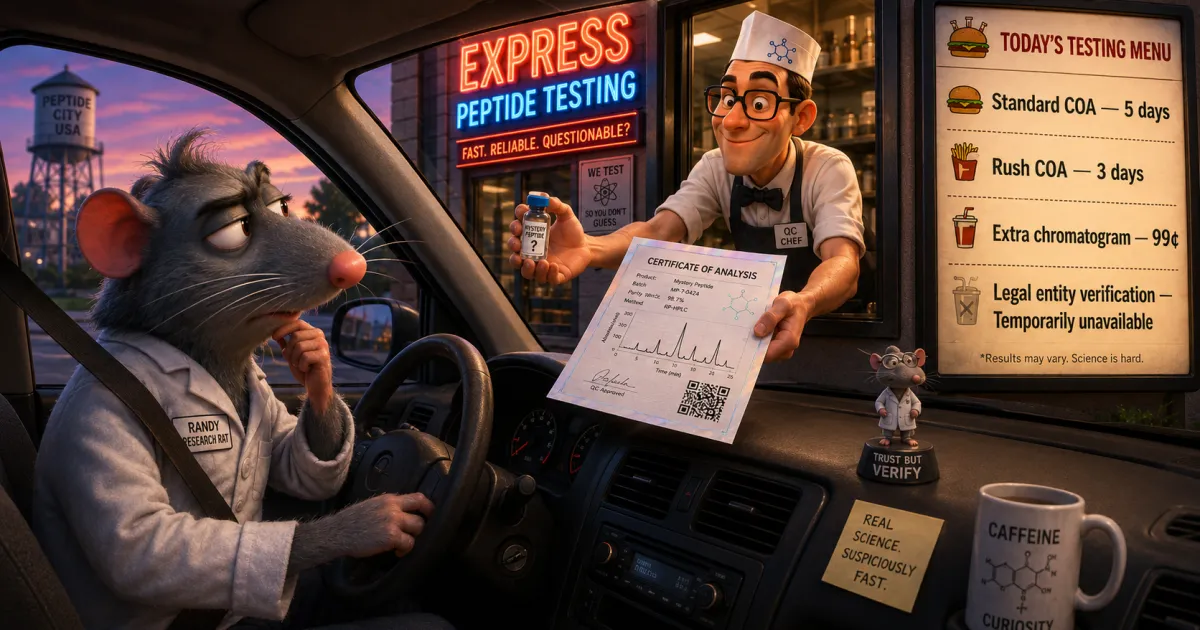
SteriGenix Analytical: Fast COAs, Missing Basics
A certificate of analysis—usually called a COA—is not magic.
It is supposed to be evidence that an independent laboratory tested a particular sample and reported what it found. But that evidence is only as trustworthy as the laboratory behind it.
Recently, SteriGenix Analytical COAs have started appearing on smaller, single-vial peptide storefronts. The reports look professional. They have black headers, chromatograms, QR codes, signatures, and plenty of scientific vocabulary.
The presentation is polished.
The operation behind the presentation is much harder to verify.
Who exactly is SteriGenix Analytical?
The website describes SteriGenix as a Jacksonville laboratory and repeatedly conducts business under the name “SteriGenix Analytical, LLC.” Its terms select Florida law and Duval County courts.
That makes Florida’s official corporate registry the obvious place to look.
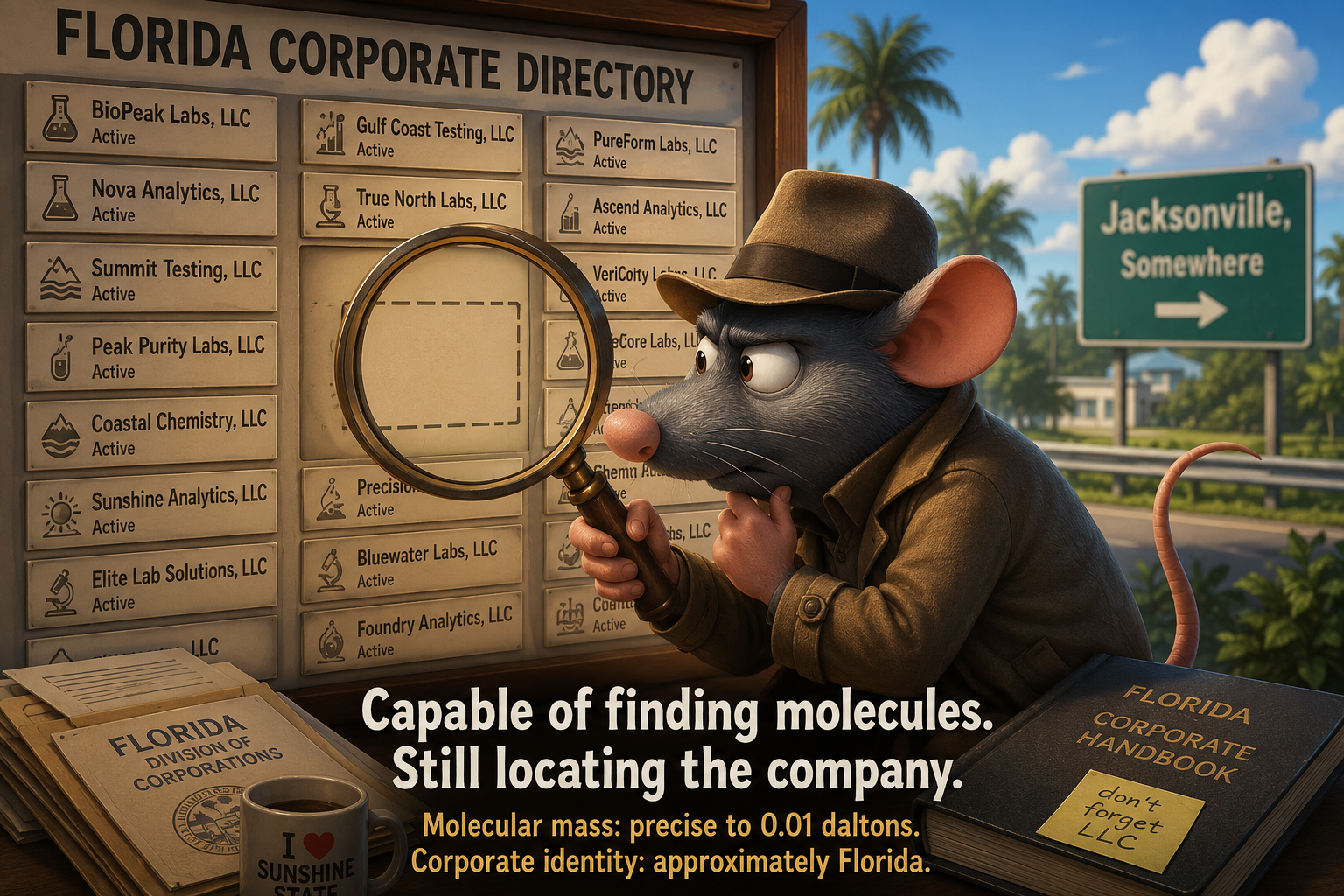
As of this review, I could not locate an entity under the exact name SteriGenix Analytical, LLC in Florida’s official business index.
That does not prove SteriGenix does not exist. It could be registered in another state, owned by a differently named company, or operating under a trade name.
But the website does not make any of that clear. It does not prominently provide a state of formation, filing number, registered agent, parent company, or complete laboratory street address. Its About page says only “Jacksonville, FL,” while the Contact page primarily offers a form and email addresses.
For a company claiming it can measure molecular mass to within 0.01 daltons, its own legal identity is surprisingly approximate.
The website appears to be brand new
Public domain-registration information appears to show that sterigenixanalytical.com was created in May 2026. That would mean the website—and possibly the public-facing operation behind it—was only a few months old when its COAs began appearing on peptide storefronts.
A new laboratory is not automatically an illegitimate laboratory. Every company starts somewhere. But when a brand-new operation is issuing reports that vendors expect customers to treat as proof of quality, its corporate identity, facility, personnel, accreditation status, and testing history deserve more scrutiny—not less.
There is also an awkward timeline issue: several of the website’s legal and policy pages say they were updated in January 2026, months before the domain apparently existed. Maybe those documents were prepared for an earlier site or copied over during development. But without an explanation, it is another small inconsistency in an operation already asking consumers to take a lot on trust.
“ISO 17025-aligned” is not accreditation
SteriGenix says it operates under an “ISO 17025-aligned” quality system. It does not say that it is ISO/IEC 17025 accredited, and it openly states that it is not a cGMP-registered facility.
That distinction matters.
Accreditation means an outside accreditation body has evaluated the laboratory’s competence for particular tests.
“Aligned” means the company says it has modeled its procedures around the standard.
Those are not the same thing.
I am NBA-aligned every time I put on basketball shoes. The Milwaukee Bucks have not called.
Until SteriGenix publishes an actual accreditation certificate, accrediting body, and testing scope, consumers should treat it as unaccredited.
The paperwork cannot agree with itself
The website gives different answers about how long laboratory records are retained.
The About page and privacy policy say raw instrument files and laboratory records are kept for at least three years. The FAQ says raw chromatograms, spectra, and metadata are retained for seven years.
The same thing happens with physical samples.
The FAQ says part of every submission is retained at −20°C for 12 months. The formal Sample Submission Agreement says the default retention period is three months.
Maybe one page is outdated. Maybe different policies apply under different circumstances.
Fine. Then say that.
A laboratory quality system is supposed to control documents. Customers should not have to spin a wheel to determine whether their sample will exist for three months or twelve.
The public COAs do not contain everything the website promises
SteriGenix says that every COA includes the methods used, raw chromatograms, mass spectra, quantitative results, and identifying information. Its peptide-testing page also says HPLC reports include an integration table.
The public reports I reviewed included summary results and chromatogram-style graphs. But they did not visibly include a mass spectrum, a peak-integration table, or a detailed analytical method.
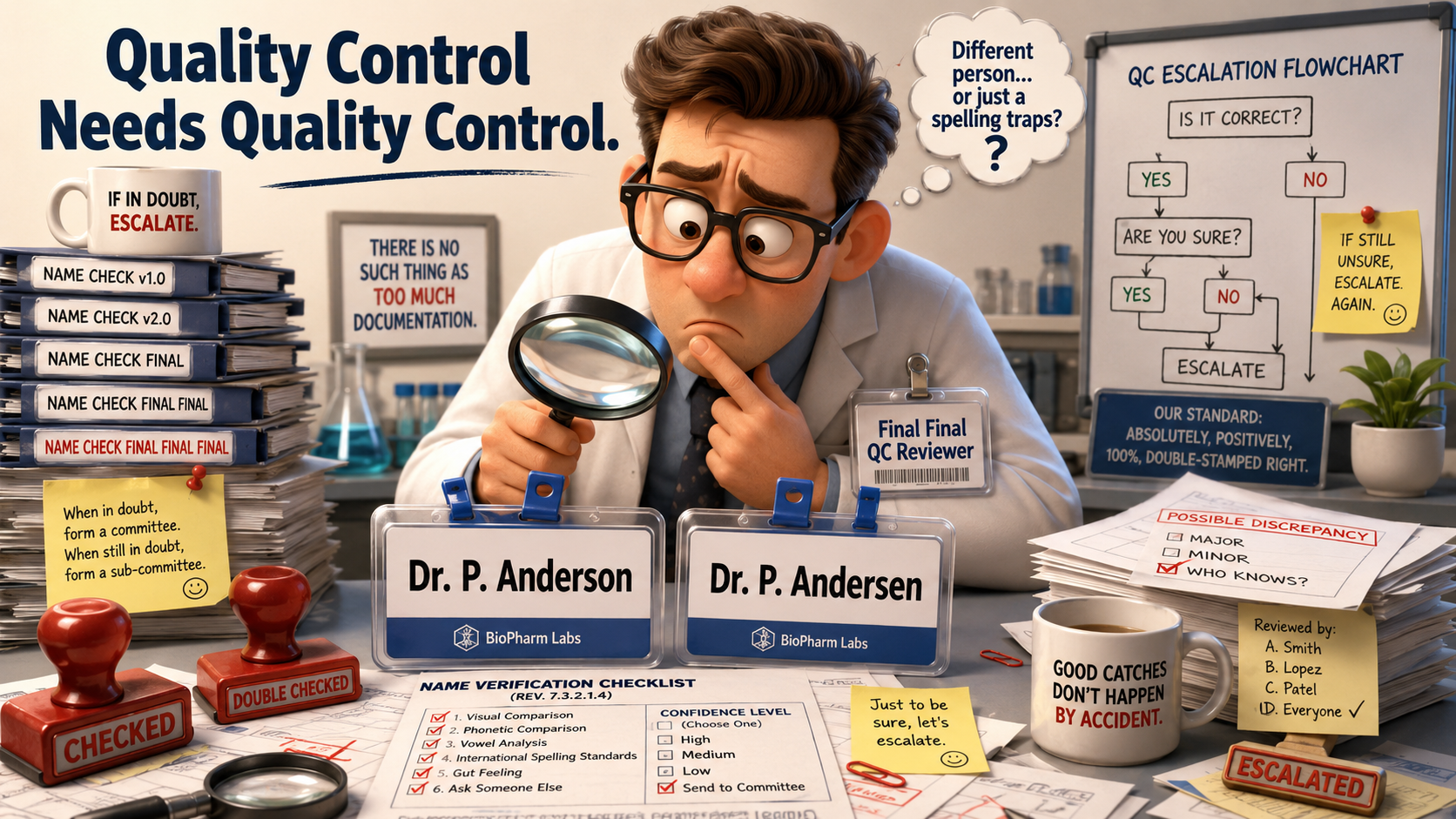
One public report identifies the QC reviewer as Dr. P. Anderson, employee ID QR-5418. Other reports identify the same reviewer ID as Dr. P. Andersen.
That may be an innocent typo.
But the typo is in the name of the person supposedly responsible for catching mistakes.
The quality-control reviewer apparently needed a quality-control reviewer.
Additional raw data may exist privately and may be available to paying clients. But that is different from saying every COA includes it. A polished picture of a chromatogram is also not the same thing as a complete, auditable analytical data package.
And a QR code only confirms that SteriGenix recognizes its own report. The QR code is not a tiny independent scientist living inside the square.
Why is SteriGenix suddenly attractive to small vendors?
The most obvious answer is speed.
SteriGenix advertises a standard turnaround of roughly three to five business days, with a three-day rush option. It also markets fast, predictable turnaround as one of its advantages.
That is extremely attractive to a small peptide store.
A vendor cannot make money from a batch sitting in a box while it waits for testing. The faster a COA arrives, the faster the product page can go live and the faster individual bottles can be sold.
That does not prove any particular vendor chose SteriGenix because other laboratories were too slow. But the business incentive is obvious.
When established testing routes are backed up, a domestic laboratory promising a report in three days sounds wonderful.
But speed is a service feature—not a credential.
A fast result is valuable only when the laboratory producing it is independently verifiable. Otherwise, the vendor has merely purchased expedited uncertainty.
Would I buy from a vendor using SteriGenix?
Not when SteriGenix is the vendor’s primary or only testing laboratory.
That does not mean I am claiming every SteriGenix result is false. I have not established fraud, fabrication, or misconduct.
The problem is simpler: the testing does not provide enough confidence for me to spend money.
A laboratory is supposed to reduce uncertainty. SteriGenix currently adds several new layers of it:
- An LLC identity that is not clearly documented
- No prominently disclosed laboratory street address
- “ISO 17025-aligned” language instead of accreditation
- Conflicting retention policies
- Reviewer-name inconsistencies
- Public reports that contain less supporting material than the website appears to promise
The vendor selected the laboratory. That makes the quality of the laboratory part of the vendor’s own due diligence.
Until SteriGenix provides clear corporate records, a verifiable facility address, transparent accreditation status, and complete supporting analytical data—or until the vendor produces an independent split-sample test from a better-established laboratory—my position is straightforward:
No independent retest, no purchase.
Three-day COAs are impressive.
Three-day answers to these basic questions would be more useful.
Editorial note: This commentary is based on publicly available records and documents reviewed on July 22, 2026.
Community Discussion