

The COA Shell Game: What Happens When a Peptide Vendor Applies to Peptide Critic
Three peptide vendors applied to Peptide Critic within a matter of hours.
All three wanted listings. Two arrived talking about affiliate commissions or promotional codes. All three said they had third-party testing.
Then we opened the COAs.
One vendor told us Janoshik performed its testing while its own certificate claimed the work happened in-house. Another repackaged an upstream supplier's Janoshik report as its own batch documentation. The third displayed five reports issued to five other companies.
All three now have red warning banners on Peptide Critic.
This explains what happens when a vendor applies and why a polished certificate is not proof that its products were tested.
A listing is not an endorsement
Getting listed on Peptide Critic is not an award or an amazing accomplishment. We accept nearly every application from an actual retail vendor with a functioning website.
The primary exception is the stream of Chinese wholesale resellers trying to turn our directory into a free advertisement for a WhatsApp number. The community forum already has a place for those sellers.
The directory exists so customers can find companies and review them publicly. That is why it includes vendors with one-star ratings and vendors with four- and five-star ratings. The reviews come from customers, not us.
Customers can upload a receipt or order screenshot. Reviews supported by that evidence receive a verified-purchase label. That confirms the reviewer documented a purchase. It does not mean Peptide Critic independently tested the product or adopted every claim in the review.
Red warning banners are different. Those are editorial notices controlled by Peptide Critic.
A listing provides access to the community. The stars reflect customer reviews. A red banner is our warning.
What we look for in a COA
“Third-party tested” appears on nearly every peptide website. Some vendors seem to think typing it is the same as doing it.
It is not.
We look beyond the purity number and ask:
- Who commissioned the test and is named as the client?
- Who manufactured or supplied the sample?
- What batch number appears on the original report?
- Does that batch match the inventory being sold?
- Did the retailer submit material from inventory it actually received?
- Can the report be verified directly with the laboratory?
- Does it confirm identity and quantity as well as purity?
- Has a vendor-created certificate changed or concealed anything from the original?
A laboratory report can be genuine and still prove very little about the vial a customer receives.
If a manufacturer tests one handpicked vial and gives the report to multiple resellers, that does not establish that every reseller received the tested batch. It certainly does not show that the retailer independently tested its own inventory.
The question is not merely whether a test exists. It is whether the tested sample can be traced to the product being sold.
Lyze Labs: Janoshik or in-house?
Lyze Labs applied for a listing and asked to become an affiliate, complete with commissions and a dedicated discount code.
We were more interested in its COAs.
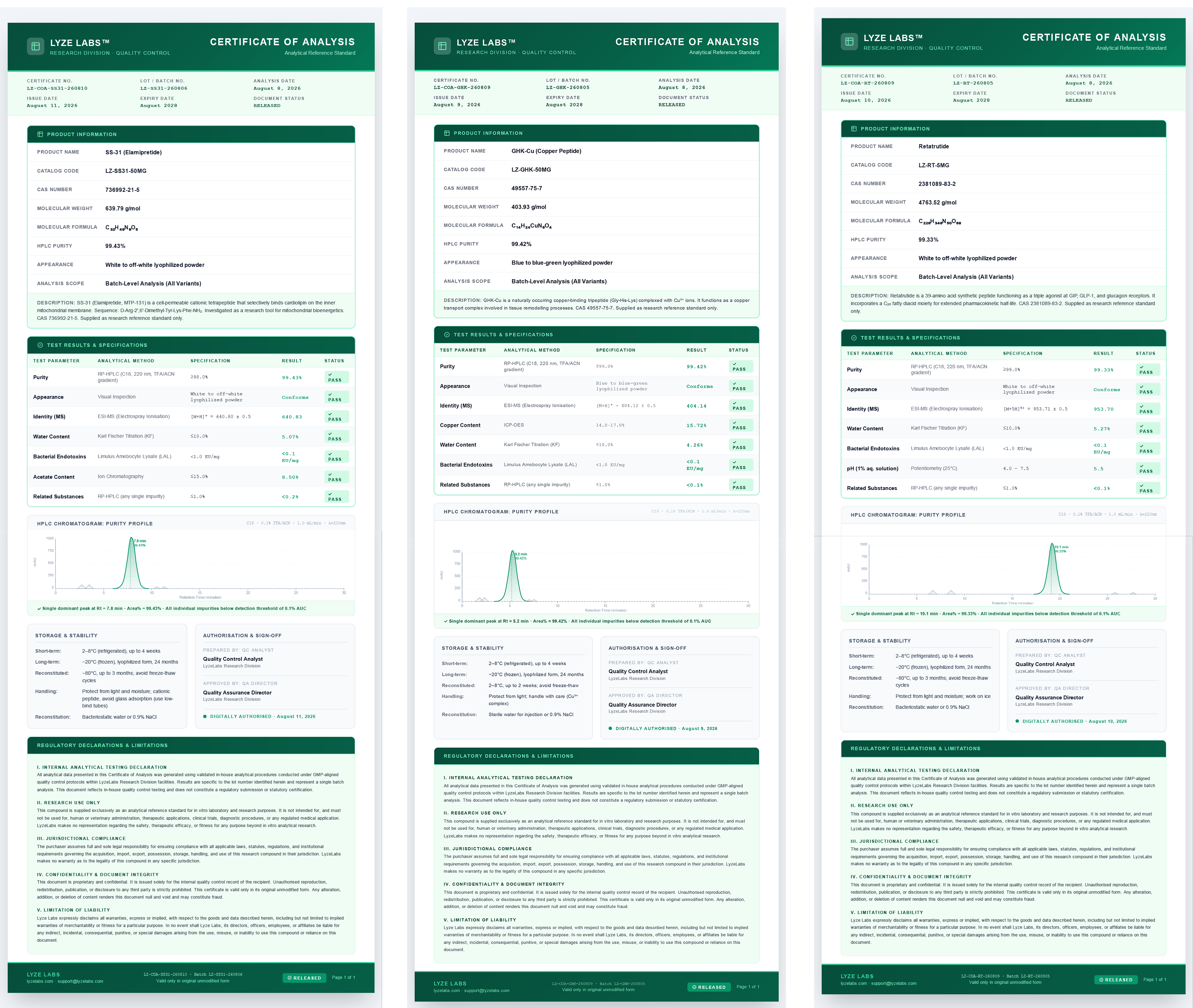
Lyze published elaborate branded certificates showing purity, identity, copper content, water content, endotoxins and related substances. One named a Lyze quality-control analyst and quality-assurance director. It also contained an “Internal Analytical Testing Declaration” stating:
All analytical data presented in this Certificate of Analysis was generated using validated in-house analytical procedures conducted within LyzeLabs Research Division facilities.
We asked Lyze whether it performed testing in-house. Its answer was direct:
No, not in-house. Samples go to Janoshik Analytical for independent HPLC and mass spectrometry.
That is not a formatting problem. It is a direct contradiction.
Lyze told Peptide Critic that Janoshik performed the testing. Its certificate told customers that Lyze generated the data inside its own facilities. Both versions cannot accurately describe the same analysis.
Lyze said Janoshik's name was not printed on the face of its certificates and offered to provide an underlying report upon request. But the problem was not simply a missing laboratory name. The certificate affirmatively claimed something else.
Whether it was produced with artificial intelligence, a template or a particularly energetic intern is beside the point. Lyze told us one thing. Its own COA said the opposite.
Molequa: a real test without the chain
Molequa claimed to provide batch-specific Janoshik documentation covering purity and identity.
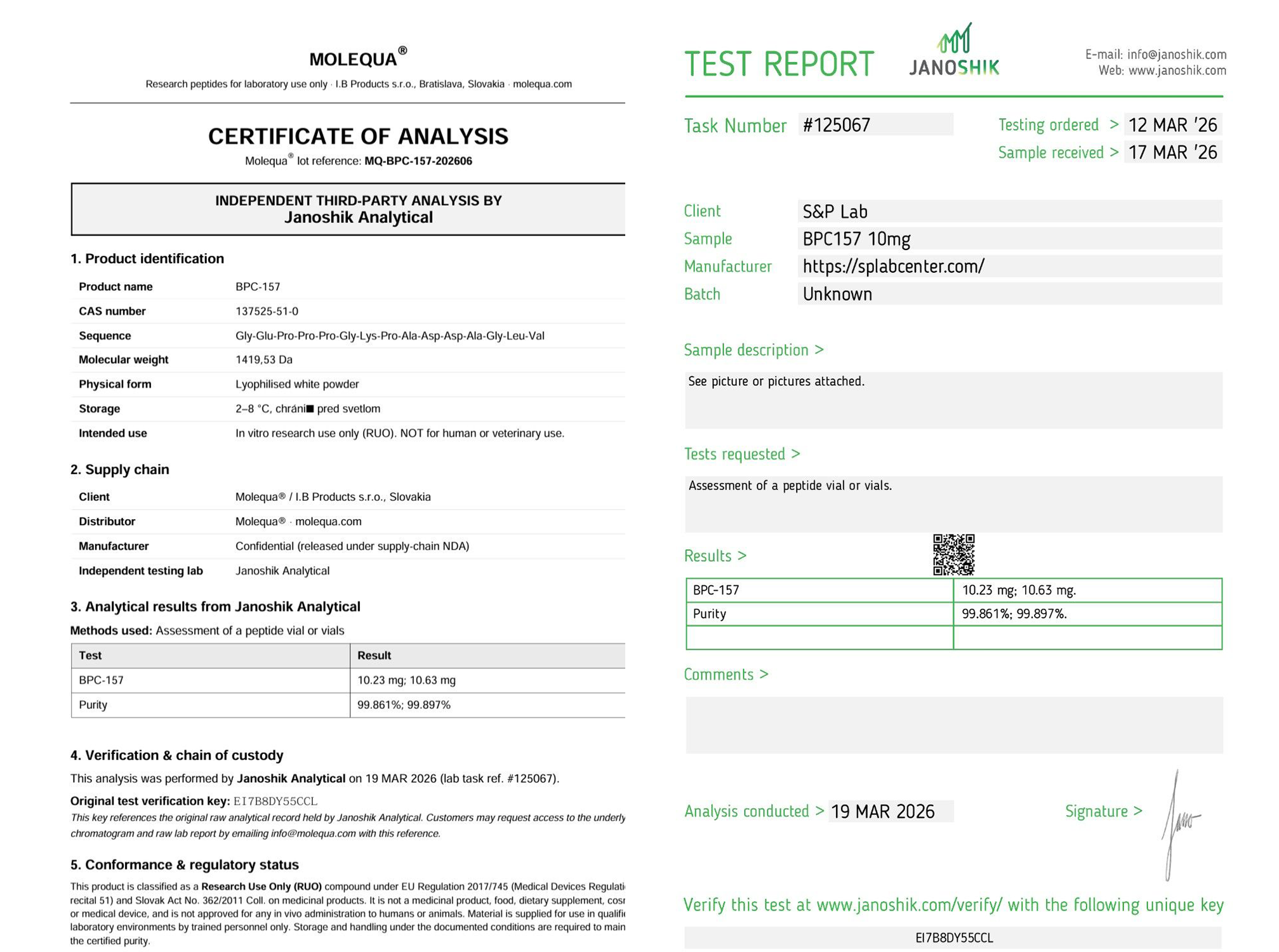
Its public BPC-157 certificate named Molequa as the client and distributor, described the manufacturer as confidential and displayed a Molequa lot reference.
The original Janoshik report did not name Molequa. It named S&P Lab as the client, splabcenter.com as the manufacturer and listed the batch as Unknown.
Molequa placed those results into a cleaner certificate bearing its own name and lot reference. What it did not provide was evidence connecting the samples tested for S&P Lab to the inventory Molequa received and sells.
After we explained the issue, Molequa acknowledged that its public COA did not establish the complete chain of custody.
Exactly.
The test may be genuine. That still does not establish that Molequa submitted a vial from its own inventory because they didn't. “Third party” means little when somebody upstream commissioned the test and the batch is unknown.
Core Research Peptides: everybody's name except Core
Core Research Peptides applied as a new Austin vendor established in 2026. It claimed every product page carried per-batch HPLC and mass-spectrometry documentation.
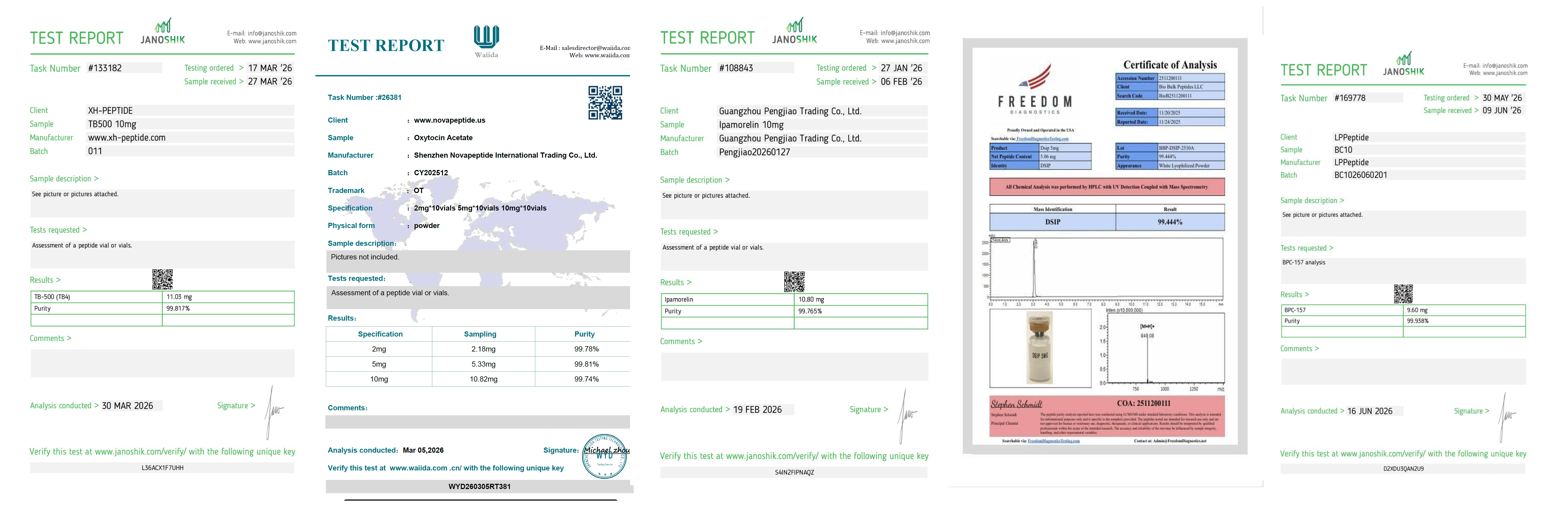
We reviewed five reports from its COA library:
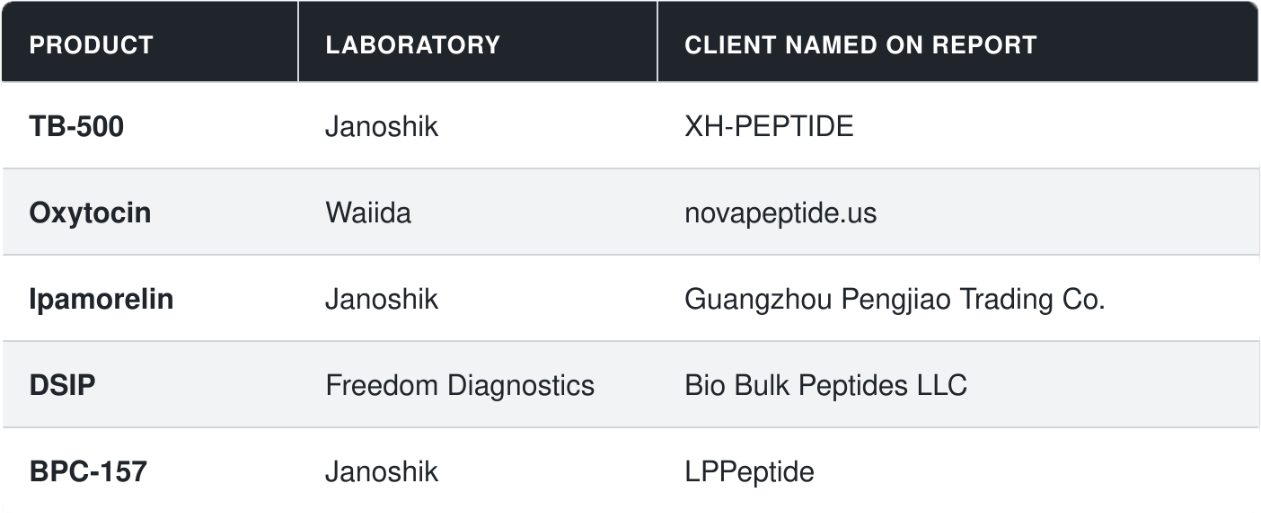
Five products. Five outside client names. Zero reports commissioned in the name of Core Research Peptides.
These companies may be Core's suppliers. That is precisely why the reports are insufficient. A supplier test does not show that Core independently tested a vial from the inventory Core received. Without documented batch mapping and chain of custody, customers cannot know whether the tested sample and the product on Core's shelf are the same.
Core did not display a testing program tied to Core. It displayed a scrapbook of reports belonging to other companies.
What responsible vendors do
Plenty of peptide vendors do this correctly.
They receive a shipment, pull samples from that inventory and send them to an independent laboratory. The report identifies the client and batch, and the vendor connects that batch to the vials offered to customers.
Sometimes a shipment fails. It may contain too little material, unacceptable purity or the wrong compound entirely.
Responsible vendors reject the material or absorb the loss. Customers usually never hear about it because the product never reaches them. We hear about it all the time.
The peptide business can carry high margins, but those margins come with risk. Independent testing is not a decorative marketing expense. Failed batches are part of the cost of operating responsibly.
What affiliate money can buy
Affiliate offers are common in vendor applications. That alone does not prove dishonesty. Peptide Critic works with affiliate vendors, and anyone accepted as an affiliate has been investigated beyond the basic requirements for a directory listing.
That investigation is not permanent immunity.
An affiliate relationship cannot control customer reviews, erase evidence or prevent a warning. Money can buy a more prominent vendor page. You can buy Randy some cheese, and he may use his crayons to make the listing look nicer.
You cannot buy a customer review. You cannot buy a star rating. You cannot buy us looking the other way. You cannot buy removal of a red warning banner.
Those banners remain until the vendor makes significant, meaningful and verifiable changes addressing the underlying problem.
Look past the purity number
Customers have been trained to look for a COA and a purity number above 99 percent. Vendors know it. That is why every product page seems to have a laboratory logo or polished PDF ready to make buyers stop asking questions.
Do not stop there.
Look at the client, manufacturer and batch. Verify the task number. Ask whether the retailer submitted the sample. Compare the original report with any vendor-created summary.
A real test performed for somebody else is still somebody else's test. A new logo does not create chain of custody. A folder full of COAs does not become a testing program simply because a vendor placed it on a website.
And a Peptide Critic listing does not mean we approved any of it.
Sometimes it simply means the vendor applied, we looked and Randy reached for the red crayon.
Community Discussion