
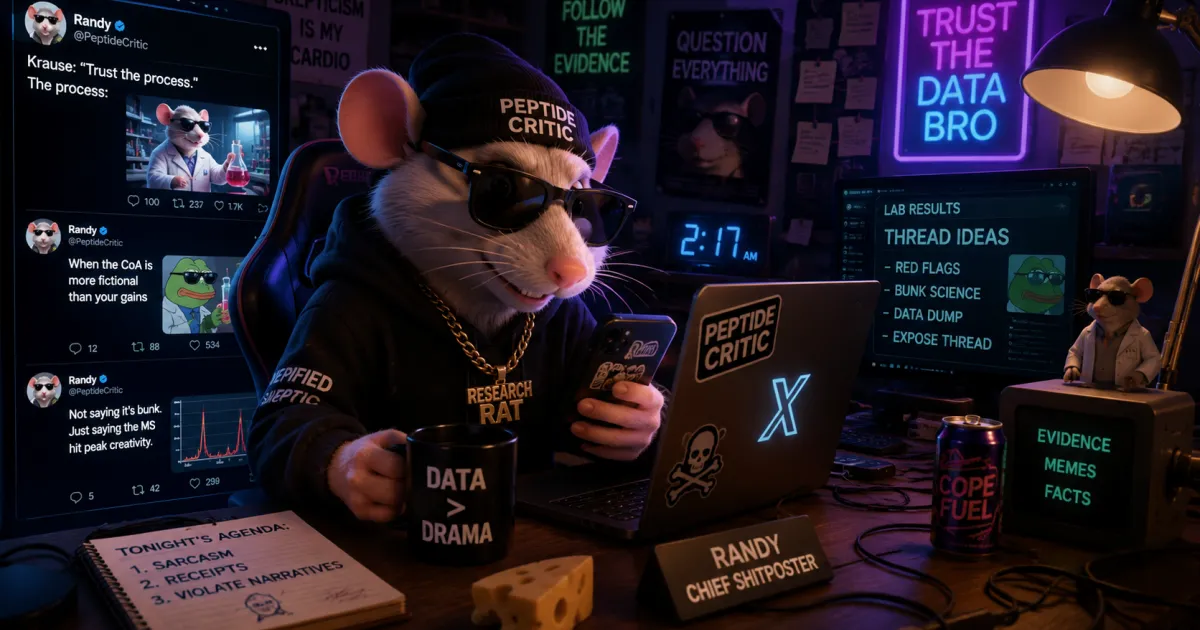
Finnrick Wants a Six-Figure Shitposter. Its Ratings Are Already a Joke.
Finnrick Is Hiring a “Gray-Market Whisperer.” That Tells You Plenty.
Finnrick tests peptides, grades vendors and tells consumers who is “Great” and who is “Bad.” Now it wants a six-figure social-media operator to turn those grades into viral content.
Finnrick wants to be the referee of the gray-market peptide world.
Consumers send in vials, Finnrick sends them to a "laboratory", and the results appear on its website with a score and vendor grade attached.
The laboratory report can be useful.
The oversized number Finnrick places above it is where things get interesting.

Meet the “Gray-Market Whisperer”
Finnrick recently advertised for a Community Engagement Lead carrying the wonderfully understated title of “Gray-Market Whisperer.”
The job pays as much as $125,000 plus equity. The successful applicant is expected to operate across Reddit, X, TikTok, Telegram and private Discord servers while recruiting testers, confronting vendors and turning laboratory reports into community content.
Finnrick even says the employee will help “translate lab reports into shitposts.”
Nothing says detached scientific authority quite like hiring a six-figure HPLC meme lord. -->
Hiring a community manager is not proof that Finnrick falsifies tests. That is not the allegation.
The problem is that Finnrick is not merely publishing raw laboratory results.
Finnrick helps collect the samples. Finnrick decides which submissions are credible enough to publish. Finnrick creates the scoring rules. Finnrick grades the vendors. Finnrick sells services to those vendors. Now Finnrick wants someone spreading its conclusions throughout the same communities that rely on them.
The referee is hiring a hype man to explain every flag.
That would be less concerning if Finnrick’s ratings accurately summarized the laboratory findings.
The Nexaph test shows that they do not.
The 99.8% Pure Vial That Earned a 4.7
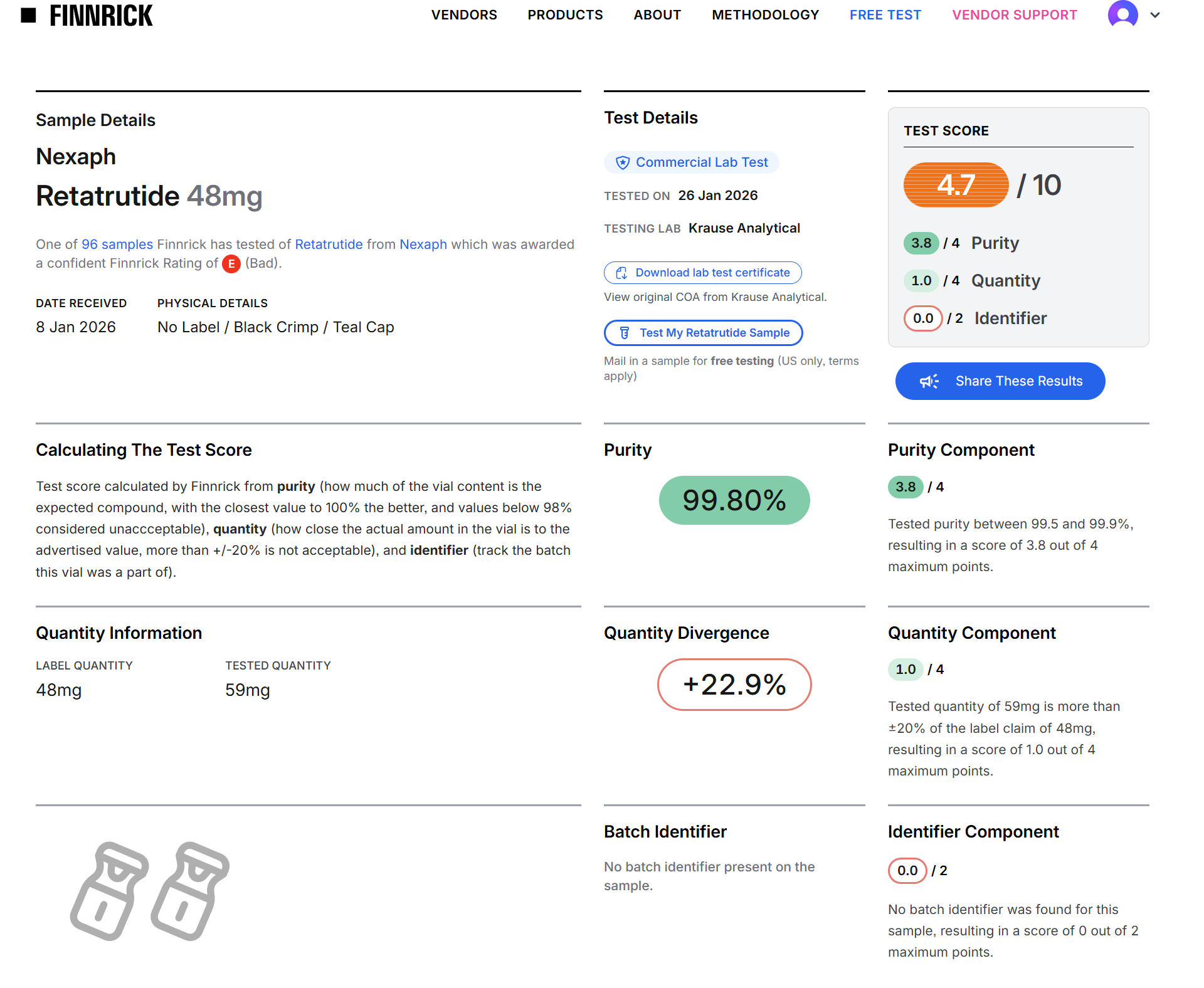
Finnrick published a test of a Nexaph vial represented as containing 48 mg of Retatrutide.
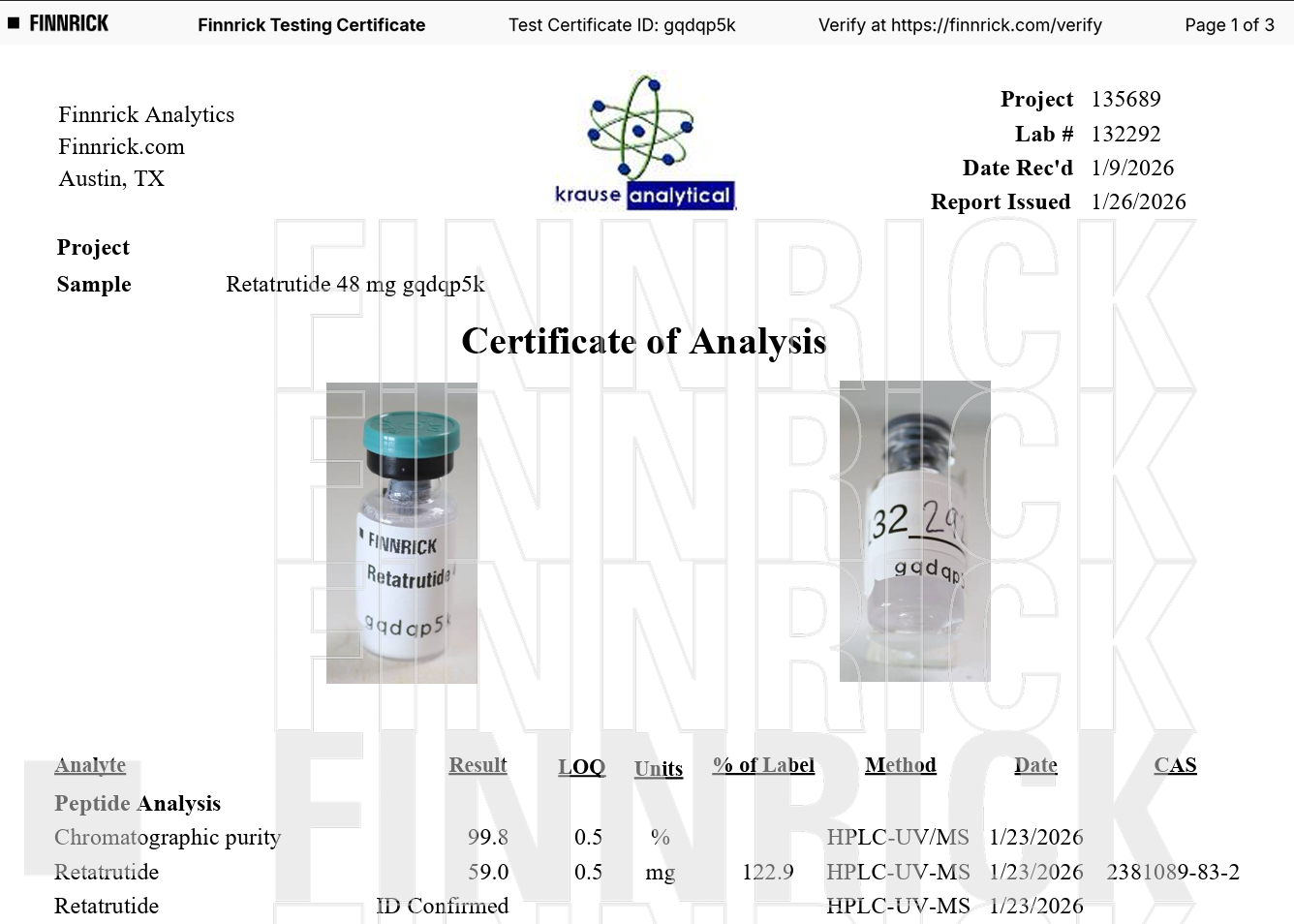
Krause Analytical found the correct compound, confirmed its identity, reported 99.8% chromatographic purity and measured 59 mg of Retatrutide.
Krause Analytical Result
Identity: Retatrutide confirmed
Purity: 99.8%
Nominal quantity (reported in the submission): 48 mg
Measured quantity: 59 mg
Finnrick Score 4.7out of 10
Yes, it contained the correct peptide.
Yes, it was nearly 100% pure.
Yes, it contained substantially more material than the nominal quantity.
Finnrick still made it look like a failed product.
Krause Confirmed the Nexaph Overfill
Nexaph is known for overfills, and it tells buyers about them. They told buyers about this one.
That does not mean Nexaph intentionally targets exactly 59 mg in every nominal 48 mg vial. It means the product is known to contain more than the nominal amount, and the actual tested fill is disclosed.
Nexaph’s own Janoshik report showed three Retatrutide vials containing 58.43 mg, 58.56 mg and 58.30 mg. Their reported purities were approximately 99.87% to 99.89%.
Krause later measured 59 mg at 99.8% purity. -->
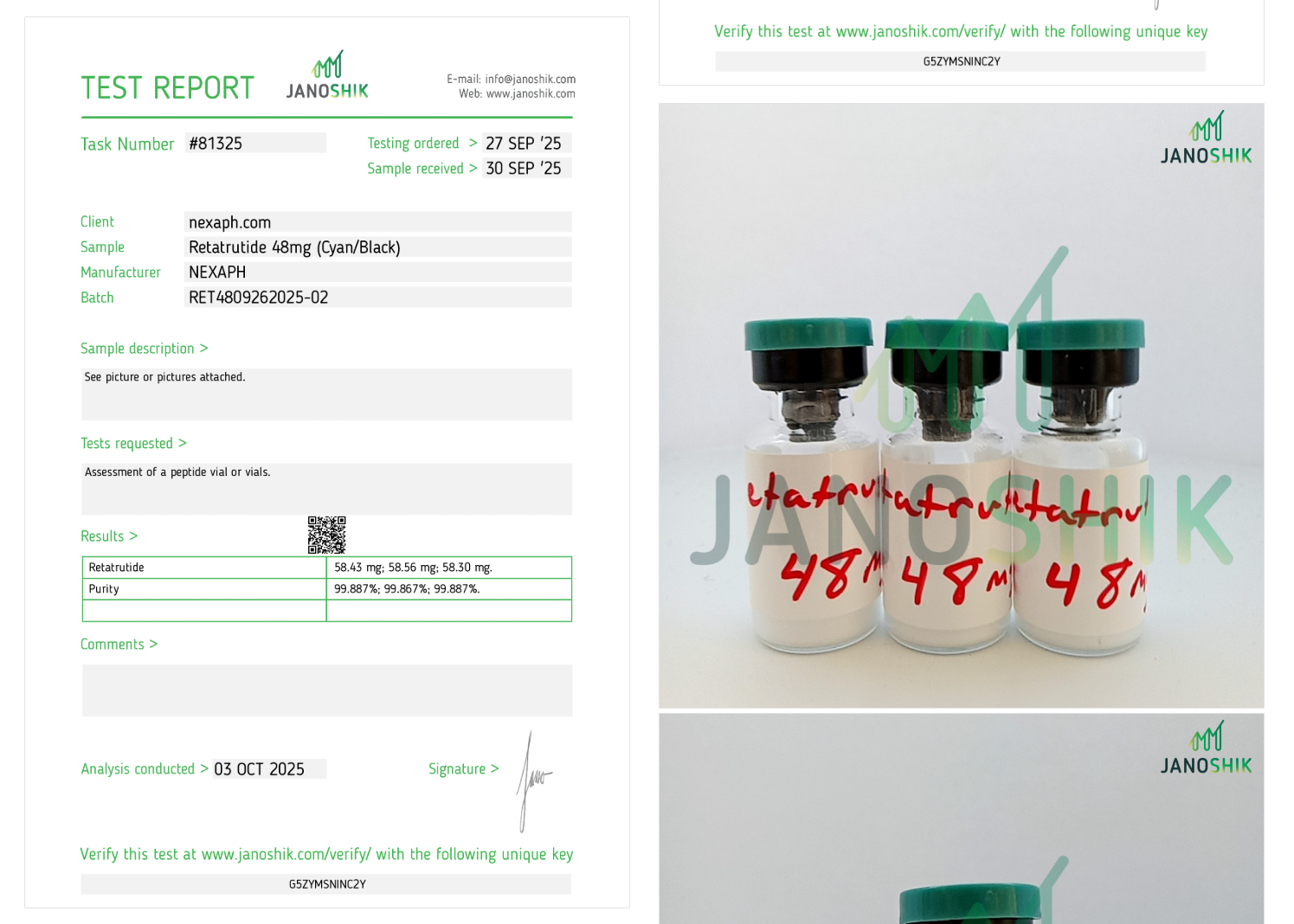
Janoshik average 58.4 mg
Krause 59 mg
Different laboratory. Nearly identical result.
Krause did not uncover an underfill, the wrong compound or terrible purity. It reproduced the known overfill pattern.
Finnrick then penalized Nexaph for it.
The laboratory found identity-confirmed, 99.8% pure Retatrutide with "extra product". Finnrick found a 4.7.
Rigged, or Just Bad at Its Job?
Finnrick gave the vial 3.8 points for purity, one point for quantity and zero points because the submitted vial lacked a batch identifier.
The missing batch information is a legitimate documentation issue. One that can be exploited by competing vendors.
Neither issue makes the peptide chemically bad.
A missing batch number is not the wrong peptide. An overfill is not contamination. Receiving 59 mg instead of 48 mg is not the same as receiving an empty vial. And again, Nexaph fully disclosed this to buyers but Finnrick didn't get the memo.
Finnrick mixes identity, purity, quantity and paperwork into one number, then presents that number like a general verdict on product quality.
A newcomer with three days on Reddit and one WhatsApp order from a profile named Jenny does not see 4.7 and think:
“Interesting. Identity confirmed, excellent purity, a known overfill and missing batch traceability.”
They think the peptide is trash.
That is why the rating system looks rigged.
The charitable explanation is that it is simply badly designed.
Finnrick can apply every rule consistently and still produce a misleading score. The system converts Finnrick’s preferences about quantity and documentation into something that looks like a scientific judgment about the peptide itself.
The laboratory result is evidence.
The 4.7 is Finnrick’s editorial opinion.
The One-Vial Guillotine
The 4.7 test is not even what gives Nexaph Retatrutide its overall E rating.
Finnrick lists 96 tests with an average score around 7.4. Yet Nexaph still receives an E — Bad because one published sample scored zero after failing identity testing.
That submission was reportedly unlabeled and had no batch identifier.
Ninety-five tests can pass. One mystery vial walks into the room, and everybody gets an E.
An identity failure is serious and should be displayed prominently.
But allowing one unlabeled, unbatched submission to control the headline grade for 96 tests is not a meaningful summary.
That is not an average. That is a hostage situation with no paper trail to back it up and they have done the same thing to countless vendors.
Anyone can send in a vial of Snap-8, say its BPC-157 from Uncle Wangs Peptide Company and smear poor old Unc Wang forever.

The Krause Problem
Krause did not make Nexaph look bad with an inaccurate quantity result. Its 59 mg measurement closely matched Janoshik’s testing.
The concern is how much artificial precision Finnrick builds on top of Krause’s results.
Krause’s own methodology describes routine peptide testing that may involve one vial, one preparation and one injection. It also discusses a check-standard acceptance range of approximately plus or minus 10% and says chromatographic values are generally meaningful to roughly two significant figures.
Finnrick then slices quantity results into scoring boundaries at 5%, 8%, 12% and 20%, complete with decimal-point scores.
That is precision cosplay.
It is like weighing a suitcase on a bathroom scale and announcing the result to the third decimal place.
The underlying measurement may still be useful. The score pretends the measurement supports more certainty than it does.
That matters near a scoring boundary. It matters even more when one result can damage a vendor’s reputation.
An identity failure capable of sinking an entire vendor grade should be confirmed using another properly documented sample, preferably through a second laboratory.
Krause should also make its current accreditation certificate, accrediting organization, testing scope and measurement-uncertainty documentation easy to inspect publicly.
“Contact us for the details” is not enough when thousands of public ratings rely on the laboratory’s work.
The Bottom Line
The Gray-Market Whisperer listing tells us what Finnrick is really building.
It is not merely a library of laboratory reports. It is a ratings company that wants to control how those reports are interpreted, packaged and circulated throughout the peptide community.
The Nexaph test shows the danger.
Krause found identity-confirmed, 99.8% pure Retatrutide in a quantity consistent with Nexaph’s own tested and reported overfill.
Finnrick turned it into 4.7 out of 10.
Then it advertised for somebody to turn results like that into shitposts.
Maybe the ratings are rigged for engagement.
Maybe the methodology is simply shit.
Finnrick can choose which defense it prefers.
The laboratory report is evidence. The Finnrick score is an opinion wearing a lab coat.
Community Discussion