
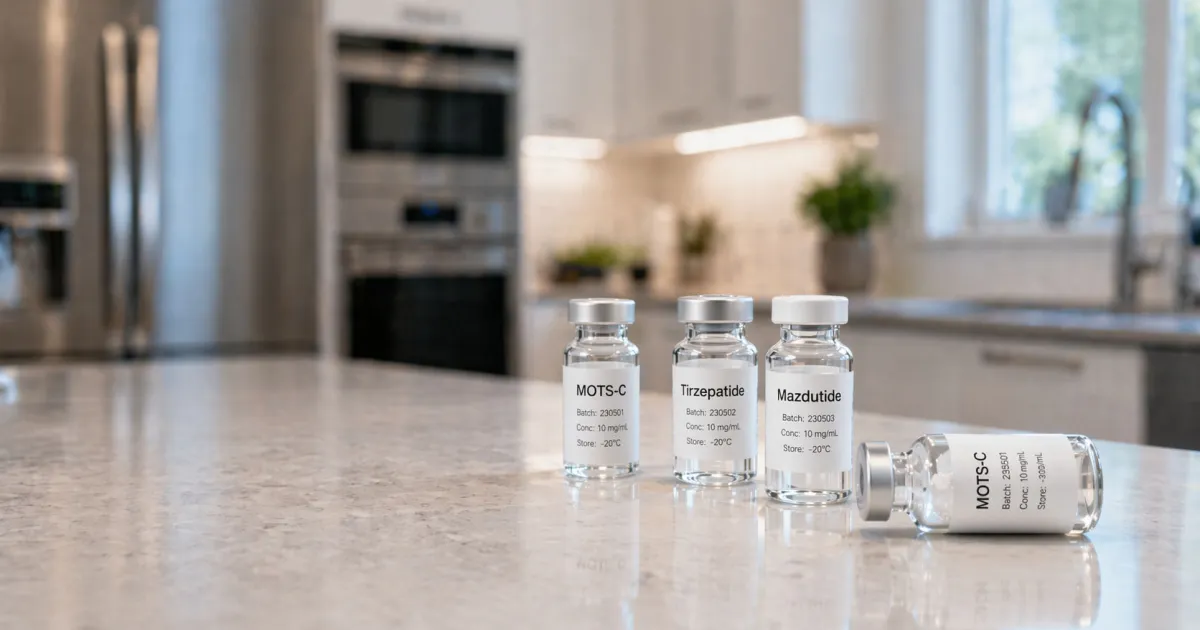
Peptide Degradation and Storage: Tirzepatide, MOTS-c, and Mazdutide Lab Results
At Peptide Critic, we get asked the same storage questions constantly.
I left it out overnight, is it ruined?
How long is reconstituted peptide actually good for?
Does refrigeration really matter that much?
Is bacteriostatic water helping, hurting, or just along for the ride?
Some of these are smart questions. Some are panic questions. Some are the kind of questions people ask after realizing their vial spent the night on the kitchen counter next to a shaker cup and leftover takeout. Either way, they all point to the same problem: most people are working off forum lore, vendor marketing, and vibes.
So we decided to stop guessing and run actual testing.
In partnership with Analytical Formulations Inc. (AFI), we evaluated the stability of three peptides over time after reconstitution: Tirzepatide, MOTS-c, and Mazdutide. The goal was simple: see how much activity remained over time under refrigerated vs ambient storage conditions, and give people something better than anecdotes to work with. Every batch used in these tests also passed endotoxin and sterility screening, which matters because degraded product is one problem, but contaminated product is a different one entirely.
How the testing worked
Each peptide was tested in duplicate. One sample was stored under tightly controlled refrigerated conditions at 36°F, and the other was stored at ambient room temperature ranging from roughly 75–80°F, averaging about 76°F. All samples were reconstituted with bacteriostatic water containing 0.9% benzyl alcohol and stored in a light-free environment. Activity was tracked over roughly four months using UV-Vis spectrophotometry, with loss inferred from changes in the extinction coefficient in the aromatic range.
In plain English: we were looking at how much usable activity remained over time, not whether a vial still looked fine to the naked eye.
The short version
Refrigeration helped across the board. That part was not surprising.
What was more interesting is that all three peptides appeared to follow a similar pattern: an initial period of slower decline followed by a much sharper drop later on. In other words, degradation did not look like a perfectly smooth, predictable slide from Day 1 to the end. There appeared to be a threshold effect where things started falling apart faster. That pattern showed up not only in room-temperature samples, but in the refrigerated ones too, which suggests temperature is not the only variable in play once peptides are reconstituted.
Tirzepatide results
Tirzepatide held up better on the counter than a lot of people would expect. The ambient sample stayed surprisingly close to baseline through the first two weeks, with 97.8% activity remaining at Day 7 and 95.0% at Day 15. Then the drop hit hard, falling to 40.3% by Day 31.
The refrigerated sample also performed well early, retaining 94.1% activity at Day 15 and 92.3% at Day 61 before eventually falling to 40.1% by Day 113.
So no, leaving Tirzepatide out briefly does not automatically mean instant death. But the data also makes it clear that short-term resilience is not the same thing as long-term stability. Refrigeration extended useful retention, but even cold storage did not preserve it indefinitely.

MOTS-c results
MOTS-c is one of those compounds that seems to attract wild claims, especially the idea that it breaks down after just a few hours. Our data did not support that.
The refrigerated MOTS-c sample retained 96.0% activity at Day 15 and 88.9% at Day 31, which is a lot different from the doom-and-gloom claims floating around. Even the ambient sample still retained 86.1% at Day 7 and 76.2% at Day 15.
That said, it was not invincible. The room-temperature sample dropped sharply to 16.9% by Day 31, and the refrigerated sample still fell to 35.4% by Day 113. So yes, we debunked the “MOTS-c dies in hours” talk, but we did not prove it is magically stable forever either.

Mazdutide results
Mazdutide ended up being the most stable of the three at room temperature in the earlier part of the study.
The ambient sample retained 78.3% activity at Day 7, 71.2% at Day 15, and 64.5% at Day 31, making it the strongest room-temperature performer of the group during that earlier window.
The refrigerated sample also held up well, retaining 93.4% activity at Day 15 and 88.5% at Day 61 before eventually falling to 38.3% by Day 113. So while Mazdutide looked the most forgiving on the counter early on, refrigeration still gave the best overall retention.

What this actually means
If your question is, I left my stuff out, is it instantly ruined? the answer is usually not that simple.
These tests suggest that reconstituted peptides can retain meaningful activity for a period of time even outside refrigeration, depending on the compound. But that does not mean room-temperature storage is ideal, and it definitely does not mean all peptides behave the same.
The bigger takeaway is this:
- Refrigeration matters.
- Short-term survival and long-term stability are not the same thing.
- Different peptides degrade differently.
- Once reconstituted, time starts mattering more than people like to admit.
It is also worth noting that all samples in this study were prepared with bacteriostatic water containing benzyl alcohol. That raises an interesting question: is benzyl alcohol contributing to the threshold-like drop we observed later in storage?
The pattern across all three compounds suggests it may be playing some role, or at least that storage temperature is not the only factor driving long-term decline after reconstitution. That does not make bacteriostatic water the villain here, because sterility still matters, but it does make it a variable worth exploring further.
Important limitations
This was not designed to be the final word on all peptide storage. It was a controlled comparison using three compounds, one diluent type, one ambient range, one refrigerated condition, and a specific analytical method. Commercial products can contain different buffers, stabilizers, excipients, or manufacturing controls that change the picture.
What this study does give us is something far more useful than recycled forum arguments: a real-world directional look at how three commonly discussed peptides behaved over time under defined conditions.
Bottom line
If you want the best retention, refrigerate your reconstituted peptides and do not drag out usage longer than necessary.
If you accidentally left something out, the answer is not always instant doom, but it also is not a free pass. Stability loss can stay modest for a while and then fall off a cliff faster than expected.
That is exactly why we ran these tests in the first place.
We partnered with Analytical Formulations Inc. (AFI) to generate data people can actually use, because peptide storage questions are not going away, and “you’re probably fine” is not a real answer.
We would rather test it than guess.
Community Discussion