
MHRA bust - A warning to DIY researchers: don’t trust pens filled in a basement
MHRA bust — a warning to DIY researchers: don’t trust pens filled in a basement
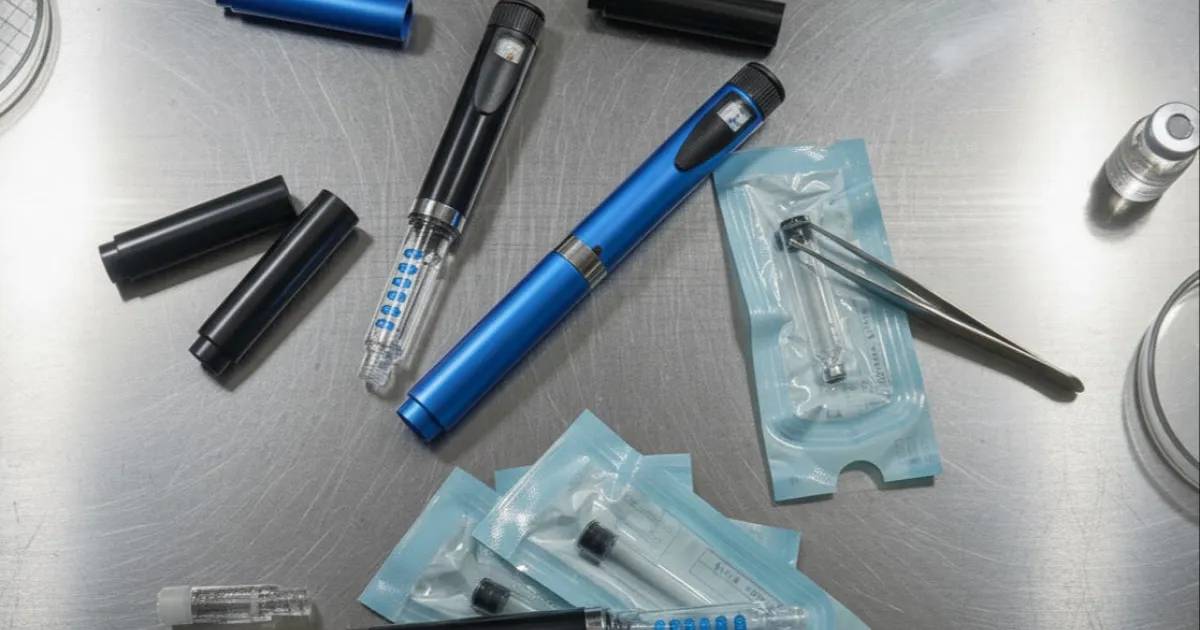
On 24 October 2025, UK regulators announced what they describe as the largest seizure of illicit weight-loss medicines ever recorded: a raid on a warehouse near Northampton that turned up tens of thousands of empty pens ready to be filled, raw chemical ingredients, and more than 2,000 finished retatrutide and tirzepatide pens awaiting dispatch. Read the MHRA press release.
The headlines are right to call this criminal—these operations are run for profit, not safety—but coverage often misses a key nuance for responsible researchers: the problem isn’t the existence of alternative suppliers; it’s the illusion of safety. Fancy labels, boxes, and QR codes don’t make a product sterile or verified. Only documented testing and controlled production do.
Watch: our disposable pens video—these are the same style of pens criminals were filling and boxing as “legitimate” product.
Let’s be blunt: when you allow some random, unlicensed operation to fill syringes or pens—whether it’s in a “warehouse” or a soggy basement—you are outsourcing the single most important part of self-directed research: sterility and provenance. Packaging is marketing; sterility and verification are science.
That’s the crux of the responsible pro–grey market position. Many people turn to grey sources because of slow clinical access, cost barriers, or an interest in investigational compounds. We don’t need moralizing like “never use anything unlicensed.” We need standards: documented sourcing, third-party testing, and aseptic technique. What we must reject is sloppy supply chains and the fantasy that slick branding equals quality.
Practical responsibilities for researchers
- Audit your source: Know who made the product, where it was produced, and what testing exists.
- Demand COAs and batch tests: Identity, potency, contamination, endotoxin, and if applicable, sterility.
- Control aseptic steps: If buying filled pens, ask how aseptic filling was done; if filling yourself, use proper laminar flow, sterile vials, and verified bacteriostatic water.
- Document and sample-test: Keep batch records; whenever possible, send a sample for independent analysis.
These aren’t bureaucratic luxuries—they’re how you avoid harm. The Northampton raid shows the alternative: untested products, unknown impurities, and a real risk of contamination that can kill. Regulators will act on that risk, and rightly so.
A pro-grey argument: regulation vs. reality
Being pro-grey doesn’t mean being pro-danger. It acknowledges that many researchers operate outside traditional pipelines out of necessity—and that this reality deserves pragmatic engagement. The aim should be to professionalize grey channels: better documentation, third-party testing, and community standards for aseptic technique. When those exist, bad actors who profit from secrecy and shortcuts lose their market. That’s good for safety and for legitimate research.
If you’re experimenting, treat supply-chain decisions as part of your protocol. Your samples, your health, and your credibility depend on it. For the official facts on the UK raid, see the MHRA statement. And if you’re using disposable pens, learn how they should be filled and handled—start with our video above or open it on YouTube.
— Peptide Critic editorial
Community Discussion