
Dammit Randy, There Are Pubes in the Peptides... Again
There are a few things you do not want to find inside a peptide vial.
Glass shards. Mystery dust. A cracked seal. Something that looks like it came from a gas station shower drain.
And yet here we are.
We are talking “sir, why is there a pube in my research peptide?” hair.
Aavant Chemistry, the gray-market Telegram seller that has built a following with aggressive pricing, domestic shipping, and the usual “trust me bro, it tested fine” energy, is once again dealing with reports of visible foreign matter in vials.
This time, the issue appears to involve the May 2026 release of Tirzepatide 30, Batch 13, with photos circulating from private Telegram testing groups showing what looks very much like hair inside a vial.
And not elegant hair. Not “maybe a fiber from packaging” hair.
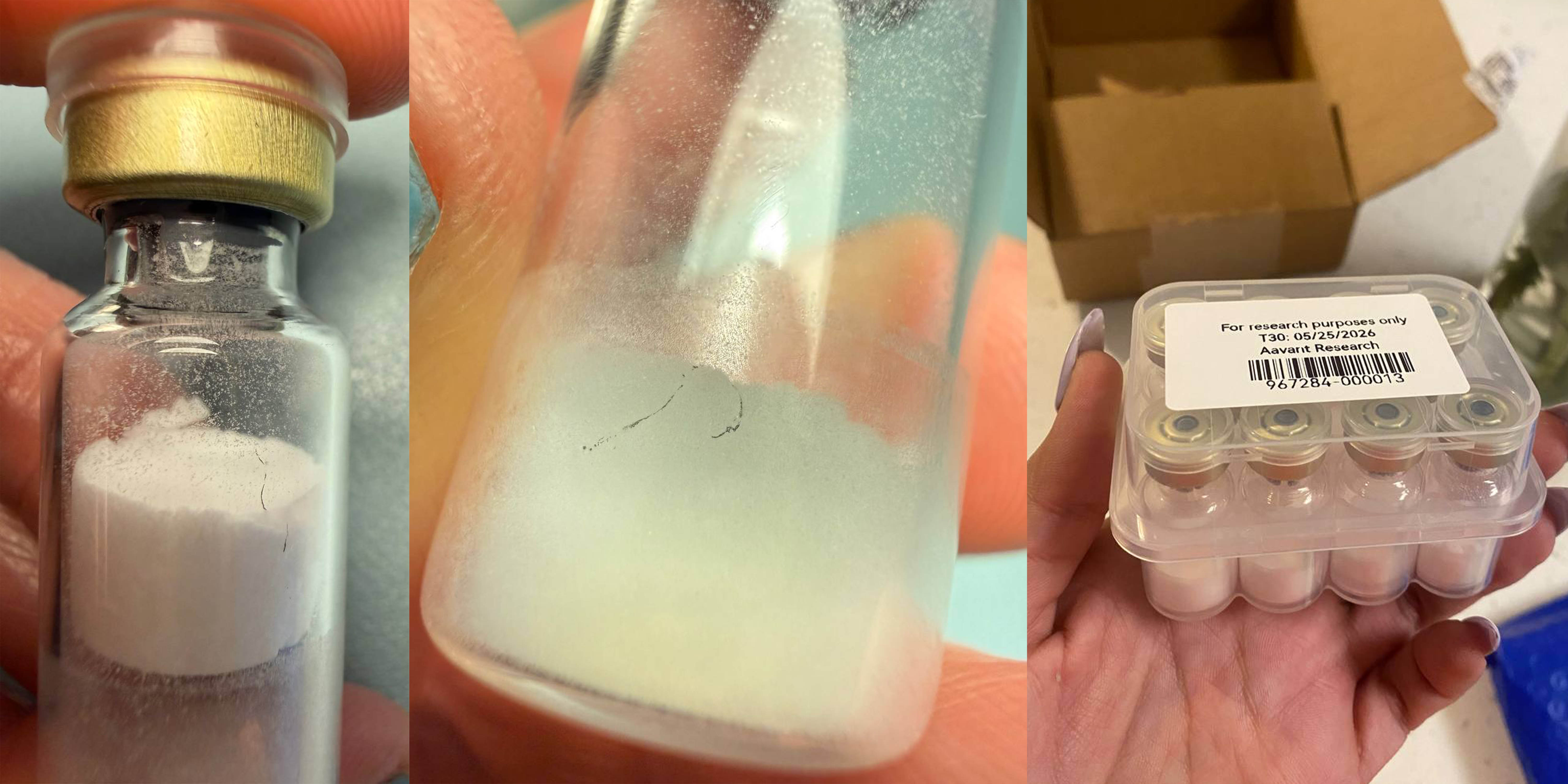
There are also photos of cracked vials, which is another fun little bonus feature nobody ordered.
Reported cracked vial from the same Aavant-related Telegram testing circles.
To be fair, at least one affected customer reportedly has already been shipped a replacement, and Aavant appears to be replacing problem vials when people complain. That is better than nothing.
But it does not answer the larger question:
If one vial has visible contamination, what is going on with the rest of the batch?
If theres a hair in your cheese platter the whole kitchen is in question!
Because peptides are not supposed to come with garnish.
The Garage Chemistry Question
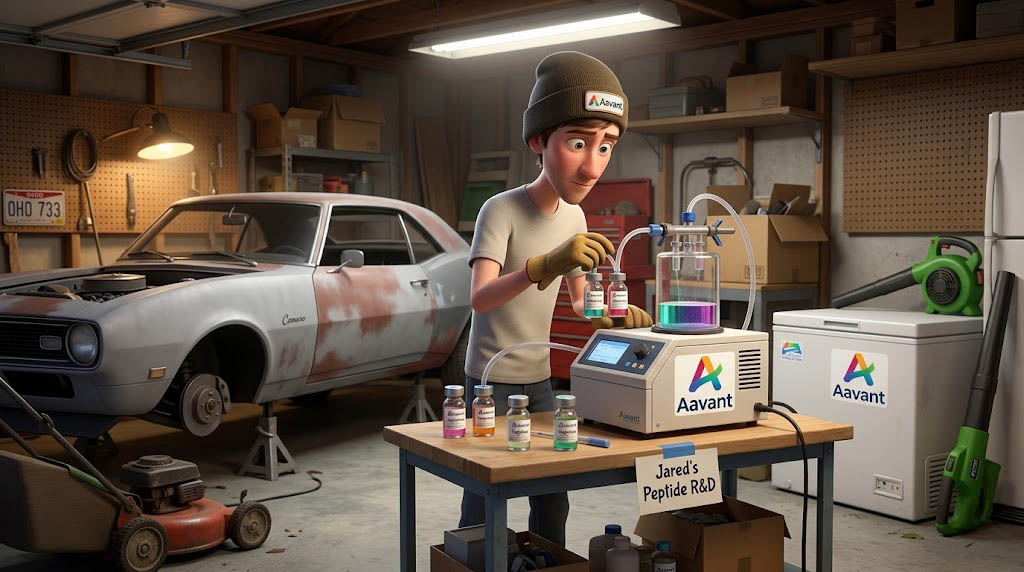
Aavant has claimed or implied that they finish or lyophilize product themselves. For a while, some people in the community have wondered whether they were actually doing that or simply dipping into Chinese finished product and moving it through the U.S. with better marketing.
But when hair starts showing up in vials, the question changes.
At that point, people naturally start asking whether this is being done in a proper clean environment or in an Ohio garage next to a leaf blower, a chest freezer, and somebody’s half-restored Camaro.
That may sound harsh, but visible contamination in a supposedly finished vial is not a small issue. Hair does not teleport into a sterile vial because Mercury is in retrograde. It gets there because something in the handling, filling, lyophilizing, capping, storage, inspection, or packaging process failed.
If your quality control program can be defeated by a single stray hair, it is not a quality control program.
It is garage chemistry with a shipping department.
I should also mention the mass/purity testing was fine.
No, “Just Filter It” Is Not Good Enough
One of the predictable responses to any contamination issue in the gray market is always some version of: “Just filter it.”
And yes, filtering matters.
At Peptide Critic, we are very pro-filtering. Filtering is smart. Filtering is useful. Filtering is one more layer of protection in a space where quality control ranges from excellent to “a man named Jared with a Telegram handle and a Foodsaver.”
But filtering is not a magic ritual that turns gross product into good product.
Filtering is a precaution. It is not a business model.
If a product has visible contamination, damaged vials, questionable handling, or a known sterility problem, the answer should not be “send it through a filter and hope.” The answer should be: why was this shipped in the first place?
A filter is a seatbelt. It is not an excuse to drive a car with no brakes into a lake.
Our position is simple: if sterility fails, it goes in the trash. Even if filtering works. Even if the product was expensive. Even if throwing it away hurts your feelings and your wallet at the same time.
Filtering is there as a backup layer. It should not be the only thing standing between your research subject and a vial that looks like it was finished during a bathroom remodel.
The China COA Disaster
The Aavant issue is only one part of the current gray-market mess. The bigger problem is what we are seeing from some Chinese-sourced product, especially reports tied by community testing and supplier tracking to Qingdao Shinan Chang Hengsheng Trading Co., Ltd.
The COAs coming back from this cluster are a disaster.
Just a few example COAs from the current China-sourced testing mess.
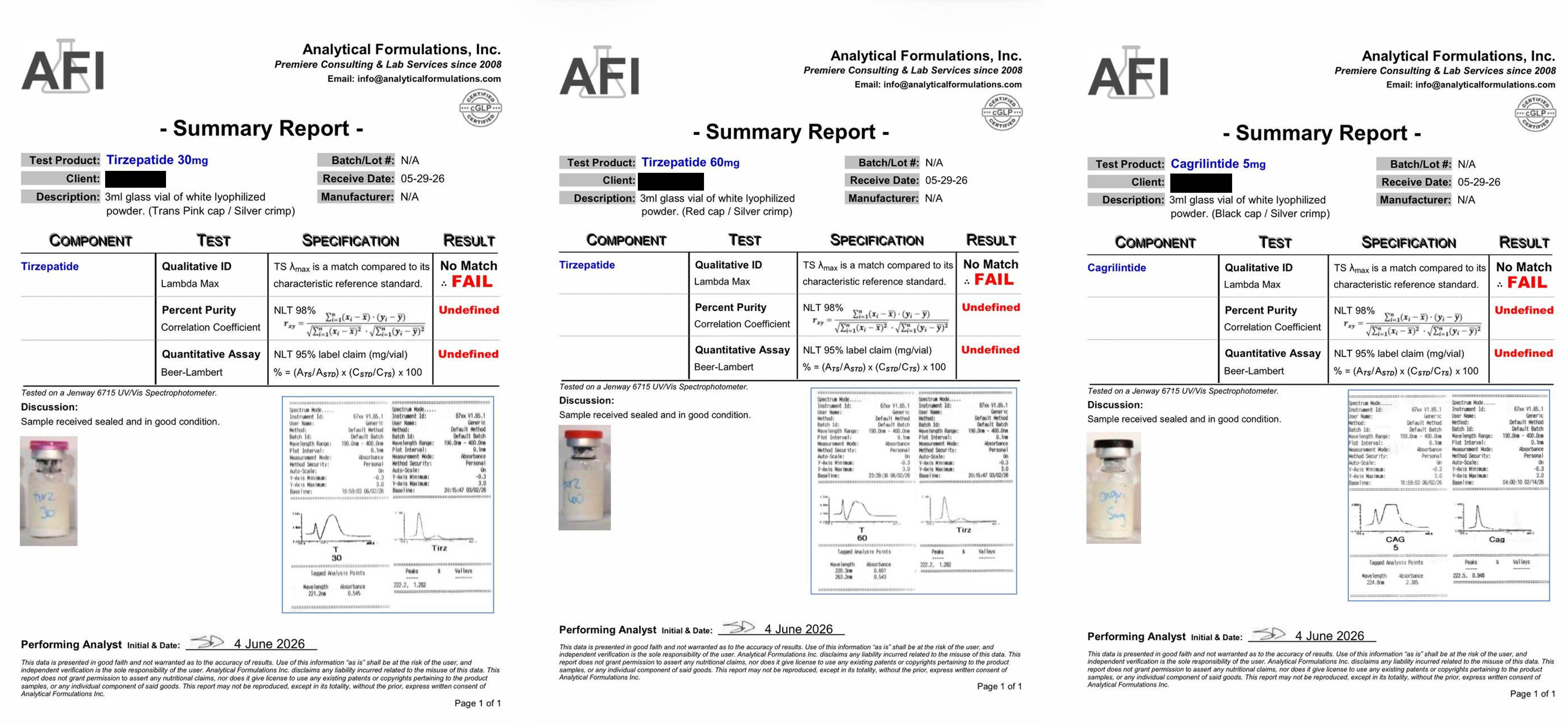
Reported failures include:
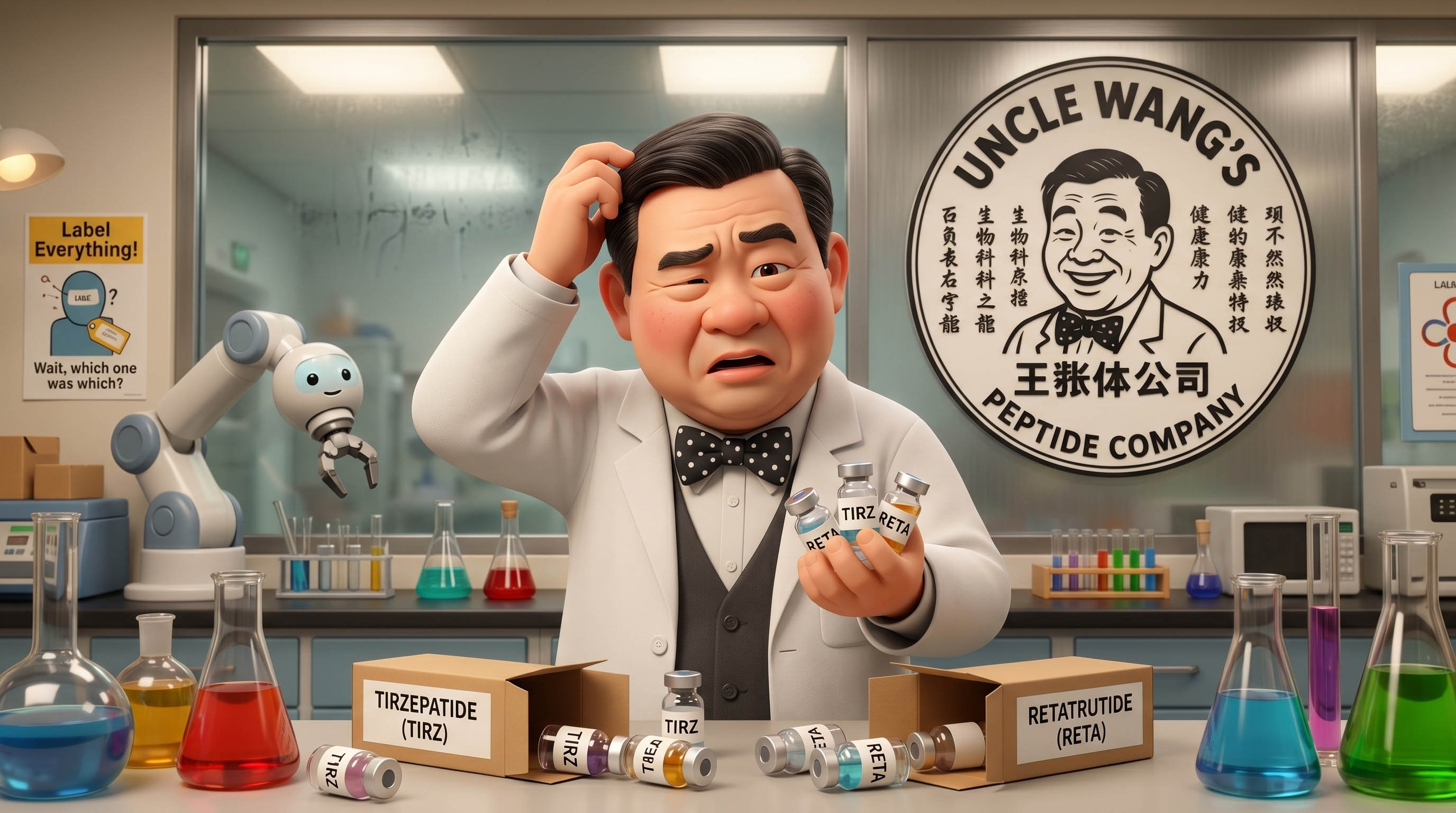
- Tirzepatide labeled as retatrutide
- Tirzepatide with no tirzepatide
- Retatrutide that appears to be no identifiable peptide
- Vials that appear to be filler
- Products that cannot be identified
- White Glow or CLO-type products allegedly coming back as tirzepatide
- One reported “reta” sample coming back as melatonin
At that point, you are not researching peptides anymore. You are playing chemical roulette with a shipping label.
This is why blindly trusting a supplier is insane. It does not matter how cheap the kit was if the vial is wrong. Saving money on retatrutide does not help if you accidentally research MT2 and your subject starts turning the color of a Home Depot bucket.
One testing source, who asked not to be named due to client anonymity, reportedly noted a pattern in the problem vials: a shorter neck and a more abrupt shoulder slope. According to that same source, a significant percentage of recent samples in this cluster have been failing.
That does not mean every Chinese supplier is bad. It does mean the current market is messy enough that “my source is solid” should not be accepted as evidence.
Trust is not a COA. A Telegram post is not a COA. A supplier saying “friend, best quality” is definitely not a COA.
The False Economy of Cheap Gray-Market Peptides
The gray market is attractive for obvious reasons.
The pricing can be ridiculous. Domestic shipping is convenient. You do not have to worry about customs seizures, trusted traveler status, or your package vanishing into a government warehouse. For a lot of people, that is appealing.
But cheap can get expensive fast.
When something goes wrong, there is often no chargeback, no return policy, no meaningful warranty, no recall, no public explanation, and no accountability beyond “we only guarantee mass and purity.”
Great. The mass is correct. The purity is fine. There is also a hair in it.
Wonderful. Very scientific. Nobel Prize for Pubic Lyophilization.
This is the part people ignore when they compare a $100 gray-market kit to a higher-priced U.S. research vendor. The price difference is not just product. It is sorting, testing, rejection, customer service, replacement policies, and someone standing between you and a mystery vial from a supplier who may or may not know whether they packed tirz, reta, GHK, melatonin, or powdered vibes.
Why Well-Run U.S. Research Vendors Still Matter
Single-bottle research vendors are more expensive. Nobody is pretending otherwise.
But a well-run vendor in the U.S. can provide a layer of accountability that the raw gray market often does not. That means better screening, easier access to COAs, clearer replacement policies, and a much lower chance that you are personally acting as the quality-control department for an overseas supplier.
Are U.S. vendors perfect? No.
Are all COAs perfect? Also no.
But there is a big difference between buying from a vendor with public testing, customer service, and a reputation to protect, versus sending USDT on the blockchain into the void and hoping the vial labeled “reta” is not actually melanotan with a dream journal.
You are not just paying for peptide. You are paying to avoid becoming an unpaid forensic chemist.
About the Telegram Photos
The photos in this article came from private Aavant-related Telegram testing groups. Publishing them will probably get me kicked out of at least one group.
That is fine. It's part of the job.
Telegram accounts have the lifespan of a gas station vape anyway.
If the cost of publishing obvious quality-control problems is getting booted from a room full of people pretending a pube vial is just “part of the game,” I will somehow find the strength to continue.
"A Vendor Is Good Until They Are Not"
Aavant had a run where the pricing, domestic shipping, and accessibility made them attractive. But visible contamination, cracked vials, quiet responses, and “just filter it” cope are not good enough.
The same goes for the China supply chain issues. The COAs are showing exactly why testing matters and why “my supplier is solid” should never be accepted as proof.
Peptides should be tested. Vials should be intact. Labels should match contents. Sterility should matter.
And call me old-fashioned, but your research product should not arrive with a bonus follicle.
The gray market is cheap because sometimes you are the quality-control department.
Right now, between the Aavant vial photos and the China COA failures, the message is pretty simple: test everything, filter as a precaution, do not research with known contaminated product, and do not blindly trust suppliers.
If your peptide vial looks like it came with its own DNA sample, maybe sit that one out.
Domestic shipping is nice.
Domestic contamination is less nice.
Community Discussion